

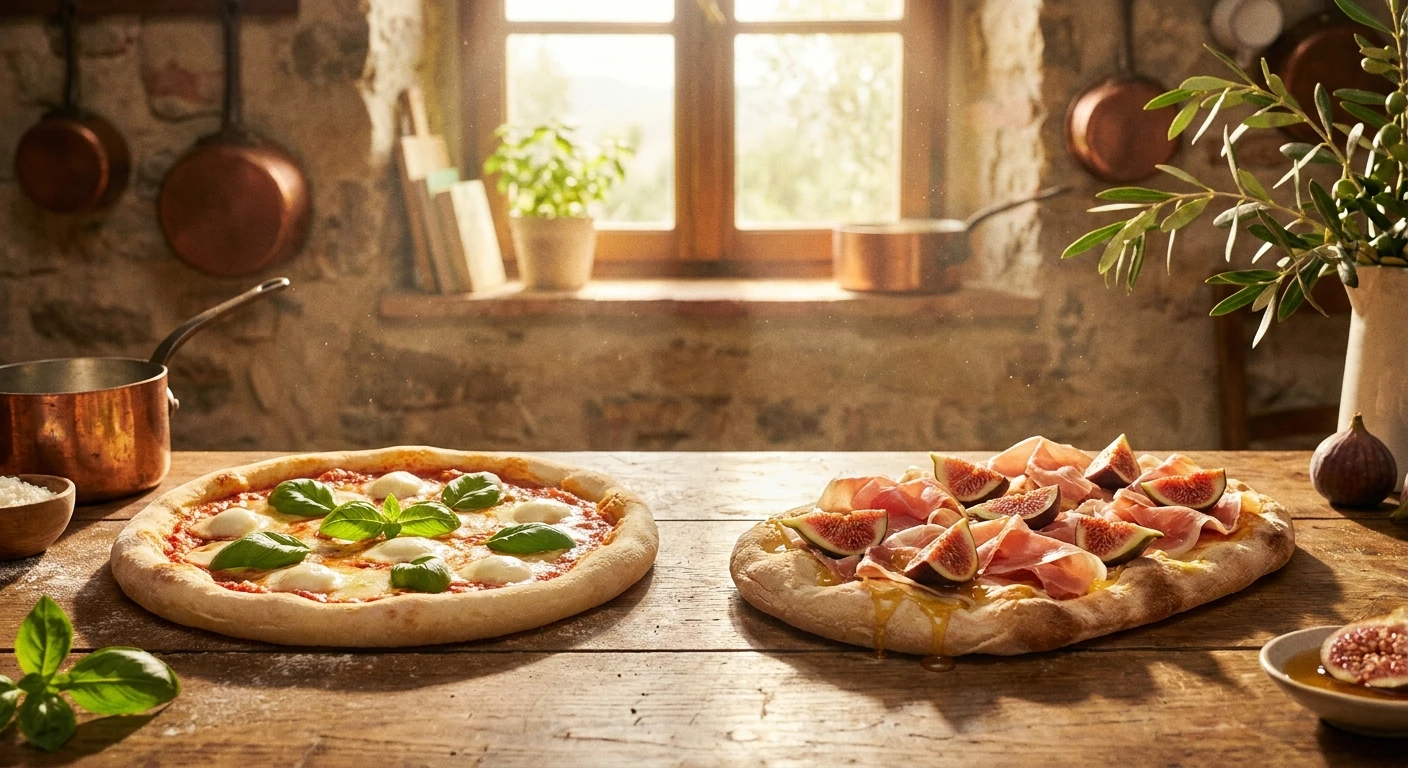
Pinsa vs Pizza: The Ultimate Italian Dough Battle
When you are standing at a busy authentic Italian bakery trying to decide between pinsa vs pizza, you might feel completely lost, but I am here to clear that up for you right now. Both of these incredible flatbreads have earned massive followings, but they use wildly different flours, specific hydration levels, and distinct baking techniques that lead to entirely unique textures and digestion experiences.
Listen, I had this exact debate last weekend. I was hanging out in a trendy little cafe in Kyiv’s historic Podil neighborhood, grabbing a coffee with a local baker friend. We were arguing over which crust reigns supreme. I kept loudly championing the classic Neapolitan chew, defending the traditional ways. He just smirked, slid a slice of cloudy, crispy, oval-shaped dough toward me topped with fresh mortadella, and claimed it was the undisputed champion of modern street food. That single, airy bite shattered my stubbornness. I realized you cannot just categorize them together. You need to respect the unique mechanics of both doughs to truly appreciate what they bring to the table.
Understanding the core differences between these two beloved styles is an absolute game changer for your palate and your stomach.
The Core Differences You Need to Know
Let me break this down for you plainly. A traditional round pie is a pure classic, generally made with highly refined 00 wheat flour, water, yeast, and salt. You toss it in the air, stretch it out, and blast it in a blazing hot oven for barely ninety seconds. The oval-shaped alternative is an entirely different beast. It relies on a highly calculated blend of wheat, soy, and rice flours. The soy adds a robust structure and fat, while the rice flour guarantees that signature shatter-crunch on the outside while keeping the inside as light as a cloud.
| Feature | Traditional Pizza | Modern Pinsa |
|---|---|---|
| Flour Composition | 100% Wheat (Usually 00 or bread flour) | Blend of Wheat, Soy, and Rice flour |
| Hydration Level | Usually 60% to 70% water | Extremely high, pushing 80% to 90% water |
| Shape and Bake Time | Round, high-temp flash bake (60-90 seconds) | Oval, lower-temp longer bake (5-8 minutes) |
Why should you choose one over the other? Here is the value proposition. If you are craving quick, stretchy, cheesy, fold-in-half goodness on a Friday night, the classic round pie is your best friend. Picture a steaming hot Margherita, simple and perfect. However, if you want a crust that will not sit heavy in your stomach—something you can confidently load up with delicate, fresh ingredients like cold burrata, prosciutto, and fig jam after it comes out of the oven—the oval flatbread wins every single time.
There are three main benefits to understanding these distinct doughs:
- You can easily cater to dietary sensitivities. The blended flours and long fermentation of the oval dough make it significantly easier on the digestive system for many people.
- You instantly elevate your home baking game. Knowing when to use high hydration versus low hydration turns you from a casual cook into a true dough master.
- You know exactly what to order. When you walk into an upscale Italian joint, you will not be guessing at the menu. You will know exactly what texture you are paying for.
The Humble Origins of the Classic Pie
We cannot talk about this topic without paying respect to the roots. Naples in the late 18th century was a bustling, chaotic port city. The working class needed food that was cheap, fast, and satisfying. Street vendors began selling flatbreads topped with tomatoes—a fruit that was initially viewed with deep suspicion by wealthy Europeans. The classic round pie was born out of pure necessity. It was peasant food that eventually conquered the entire globe, becoming a cultural staple on every single continent.
The Evolution of the Roman Flatbread
Here is where the story gets wild. Many people believe the oval flatbread is an ancient Roman recipe eaten by gladiators. The truth? It is a brilliant modern invention disguised as an ancient tradition. Corrado Di Marco, an Italian entrepreneur and baker, invented the specific flour blend and the name in 2001. He wanted to create a healthier, more digestible alternative to the heavy doughs dominating the market. He totally fabricated the ‘ancient Roman’ backstory as a marketing tactic, and honestly, it worked perfectly. People loved the story, but they loved the taste even more.
The Modern State of Italian Dough
Now that we are deep into 2026, the culinary landscape sees both of these styles living in total harmony. From tiny neighborhood corners to Michelin-starred dining rooms, bakers are relentlessly pushing the boundaries. You will find chefs experimenting with sourdough starters for both styles, blending local Ukrainian grains into the traditional Italian recipes, and serving them side by side. There is no longer a need to fiercely defend one; they both hold a permanent place in our hearts and kitchens.
The Science of Hydration and Fermentation
If you want to bake like a pro, you must grasp the underlying science. The magic word here is hydration. The classic Neapolitan dough usually sits around 65% hydration. This creates a dough that is easy to handle, stretch, and toss. The oval flatbread, conversely, pushes hydration to the absolute limit, often reaching 85% or even 90%. Working with dough this wet is like trying to shape a puddle. It requires intense patience and a completely different folding technique to build enough gluten structure to trap the gases.
Why Flour Blends Change Everything
The specific mix of flours is not just for flavor; it is a chemical necessity. When you introduce rice flour into the mix, you fundamentally change how the dough absorbs water and reacts to heat.
- Rice flour absorbs massive amounts of water without becoming gummy, which guarantees that loud crunch when you take a bite.
- Soy flour lowers the overall glycemic index and adds essential proteins that help maintain the structure of the massive air pockets.
- The cold fermentation process, which can last up to 72 hours, breaks down complex starches into simple sugars, doing half the work of digestion before the food even hits your stomach.
- High hydration creates what bakers call ‘alveolation’—those gorgeous, sprawling air bubbles you see when you slice the crust open.
7-Day Italian Dough Mastery Plan
Ready to get your hands messy? I put together a brutal but rewarding 7-day schedule to help you master both of these doughs in your home kitchen. Follow this step-by-step.
Day 1: Sourcing Your Flours
You cannot fake this. Go to a specialty store or order online. You need a high-quality 00 wheat flour for your classic pie. For the other, you need to track down a legitimate pre-mixed blend, or carefully weigh out your own mix of wheat, rice, and soy flours. Do not skip the digital scale; precision is everything here.
Day 2: Mixing the Classic Pizza Dough
Start with the basics. Mix your water, yeast, 00 flour, and salt. Knead it aggressively for about fifteen minutes until it is perfectly smooth and elastic. Ball it up, cover it tightly, and throw it in the fridge for a slow 24-hour cold ferment to develop those deep, complex flavors.
Day 3: Assembling the Pinsa Blend
This is where things get sticky. Mix your blended flours with ice-cold water. You are not kneading this; you are gently folding it. You will perform a series of stretch-and-folds every thirty minutes for two hours to build strength in the ultra-wet dough. Once it holds a shape, it goes right into the fridge.
Day 4: The Long Cold Fermentation
Do absolutely nothing. Just let the yeast do its job. The classic dough is ready, but the highly hydrated dough needs a full 48 to 72 hours in the cold to properly break down those complex starches and develop its signature airy texture.
Day 5: Baking the Classic Margherita
Pull your round dough out and let it come to room temperature. Crank your oven as hot as it will legally go. Stretch the dough, top it sparsely with crushed San Marzano tomatoes and fresh mozzarella, and bake it on a pre-heated steel until the edges are beautifully charred.
Day 6: Shaping and Pre-baking the Oval
Handling this wet dough requires heavily floured hands. Gently press it out into an oval shape on a massive bed of rice flour. Do not pop the bubbles! Pre-bake the naked crust for about five minutes. Then, pull it out, add your toppings, and bake it again until golden and crispy.
Day 7: The Ultimate Taste Test
Sit down with both finished products. Notice how the classic pie folds perfectly, while the oval crust holds completely rigid when you pick up a slice. Experience the distinct textures and congratulate yourself on mastering the two best flatbreads on earth.
Myths vs Reality
There is a lot of garbage information out there regarding these two foods. Let me clear up a few glaring misconceptions.
Myth: The oval flatbread is an ancient recipe eaten by Julius Caesar.
Reality: It was invented in 2001 by an Italian businessman. The ancient history was a pure marketing gimmick that tricked the entire world.
Myth: Classic dough is inherently terrible for your digestion and will make you bloated.
Reality: A properly fermented Neapolitan dough, made with quality ingredients and rested for 24 hours, is highly digestible. The problem is cheap, fast-food chains rushing the process.
Myth: You absolutely need an expensive wood-fired oven to make these at home.
Reality: While a high-temp oven helps the classic pie, the oval crust actually thrives beautifully in a standard home oven because it requires a lower, slower bake.
Frequently Asked Questions
Is pinsa healthier than pizza?
It can be. The addition of soy and rice flours, plus the massive water content and long fermentation, results in fewer calories per bite and an easier time for your stomach.
Can I use regular all-purpose flour for the oval dough?
Absolutely not. You will just end up with wet, sloppy bread. You need the specific blend of rice and soy to achieve the correct texture.
Why is it always shaped like an oval?
The shape is intentional. The ultra-wet dough is too fragile to spin in the air, so bakers gently stretch it out by pressing their fingers into it, naturally forming a long oval.
Does the classic pie have more calories?
Typically, yes. Because it has less water and more dense wheat flour, a slice of the classic round pie usually packs a higher caloric punch.
Can I freeze both doughs?
Yes, you can freeze them after the first fermentation, but the highly hydrated dough is notoriously difficult to handle once thawed. Fresh is always better.
What toppings go best on the oval crust?
Because the crust is so rigid and airy, it is perfect for heavy, fresh toppings applied after baking. Think mortadella, stracciatella cheese, crushed pistachios, and hot honey.
Is the modern blend gluten-free?
No. While it contains rice and soy, the main ingredient is still strong wheat flour to provide the necessary gluten network. It is not safe for celiacs.
The Final Verdict
The battle between these two incredible flatbreads is not about crowning a single winner. It is about understanding what you are craving. If you want a fast, traditional, comforting slice, the classic pie will always be there for you. But if you are chasing an airy, shattering crunch that leaves you feeling light and energetic, you know exactly what to reach for. Stop staring at the menu and get into the kitchen. Grab your flour, start mixing, and experience the magic of both doughs yourself!
Leave a Reply