

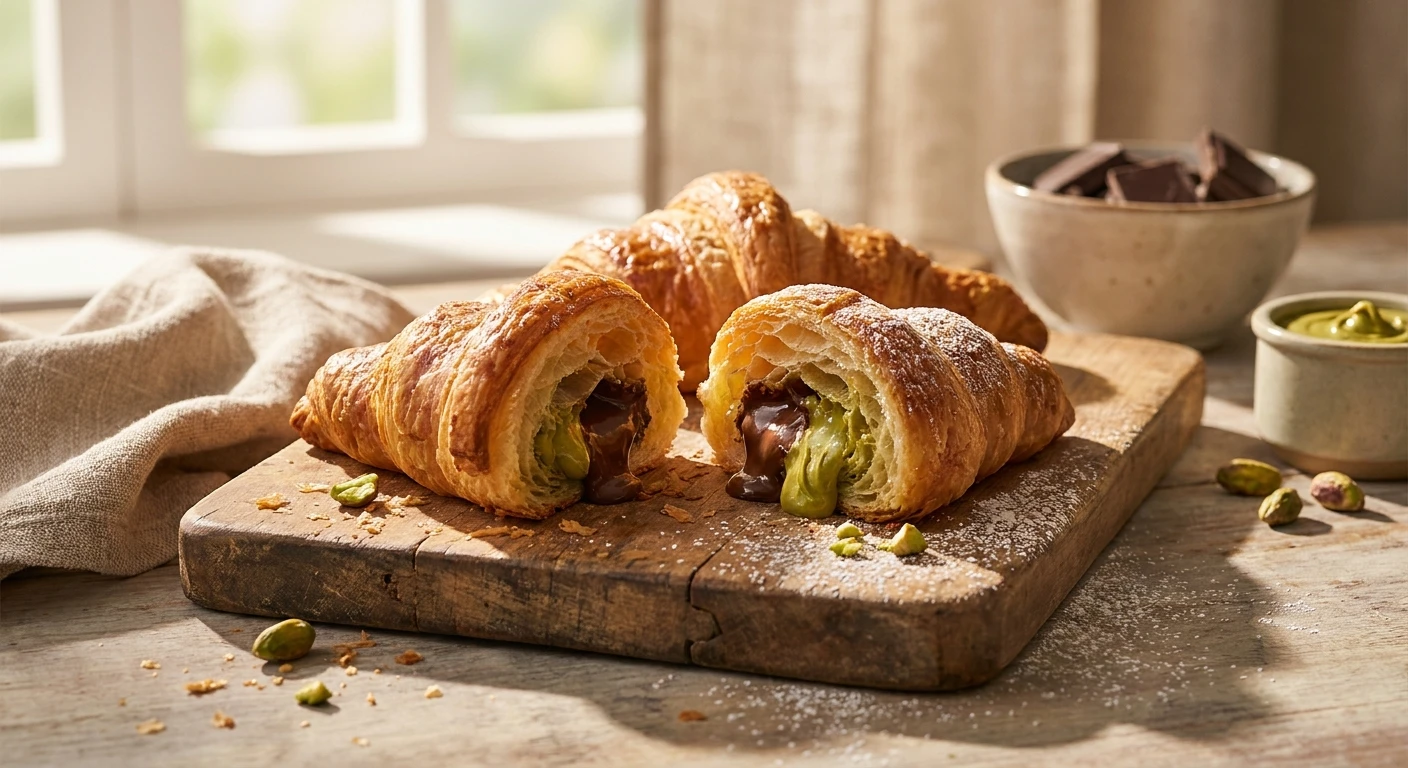
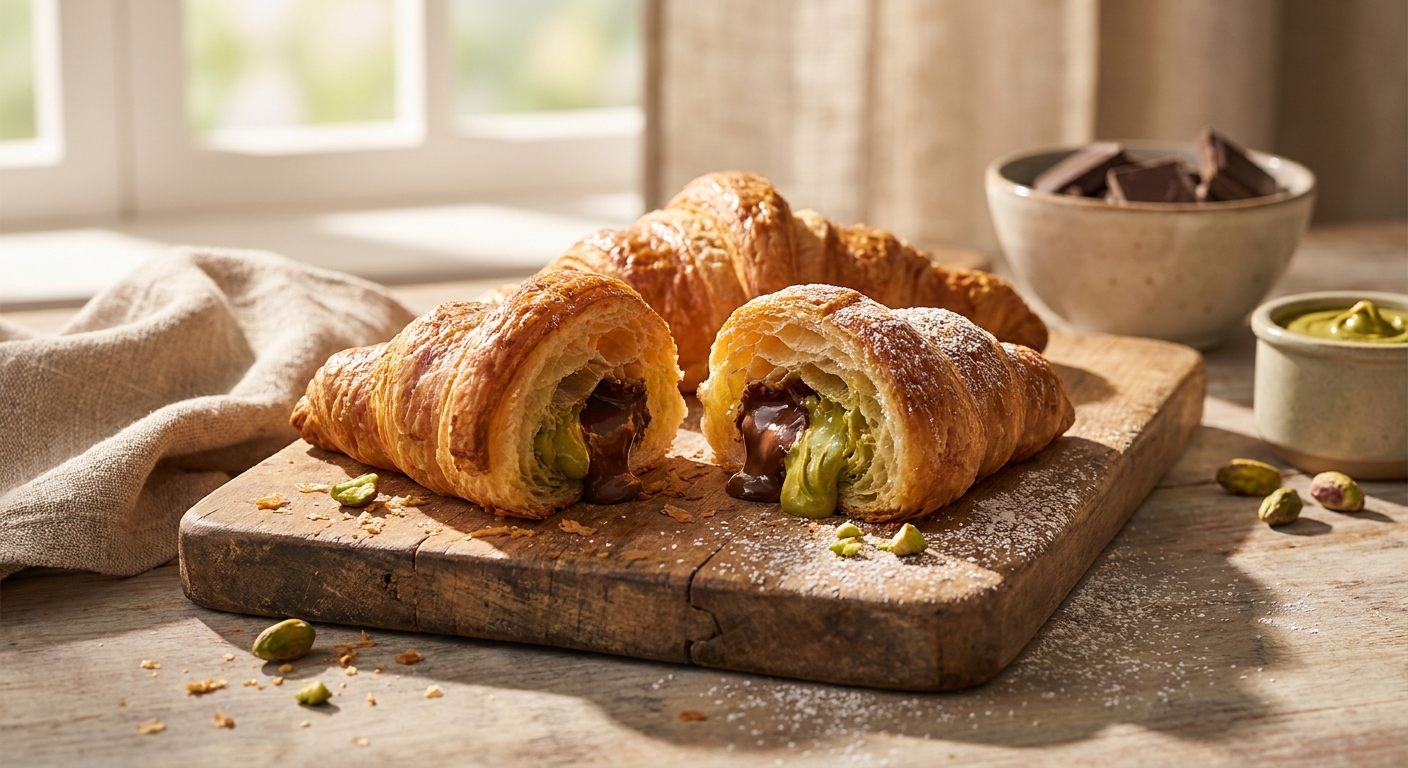
Why Filled Croissants Are Taking Over the Bakery Scene
Tell me I am not the only one completely obsessed with exactly how perfect filled croissants taste with a strong morning coffee. Hooking you with that first buttery crunch, followed by an explosion of rich, velvety cream, these pastries have practically ruined regular breakfast food for me. Seriously, once you experience that texture contrast, there is no going back to plain toast.
Just last week, I was hanging out in a tiny, tucked-away coffee shop in Lviv, right near the cobblestones of Rynok Square. The barista handed me this massive, golden crescent that felt ridiculously heavy. I tore it open, and absolute magic happened: a bright, tart raspberry coulis spilling over a thick layer of whipped mascarpone. The flaky shards of dough went everywhere, but I didn’t even care. That specific combination of local Ukrainian dairy mixed with classic French technique completely blew my mind. It got me thinking about how we treat these stuffed wonders.
They are not just pastries anymore; they are entire dessert experiences packed into a handheld vessel. Whether you are hunting for the ultimate pistachio-stuffed treat or wanting to challenge yourself in the kitchen, mastering the nuances of these decadent creations is absolutely worth your time. Let me break down exactly why these beauties reign supreme, how you can spot the top-tier ones, and even how to make them yourself.
The Anatomy of a Perfect Stuffed Pastry
When you bite into a properly constructed pastry, you are experiencing a masterclass in balance. The crispy, laminated exterior creates a necessary structural barrier for the dense, luscious interior. You simply cannot just inject random jam into dough and expect greatness; it is a calculated culinary equation that requires the right moisture control. The sheer benefit of adding a core flavor is that you get a complete dessert—or even a savory meal—without needing a fork and knife.
Take, for example, the legendary frangipane variation. By utilizing an almond cream interior, the baker adds immense moisture and a nutty richness that complements the butter perfectly, often using day-old dough to soak up all that incredible syrup. Another fantastic example is the savory route. Imagine pulling apart a warm, flaky shell to find pulled pork, caramelized onions, and sharp cheddar waiting inside. It functions as a highly satisfying, portable lunch.
Of course, there is a tiny drawback: the absolute mess. You are going to get buttery crumbs all over your favorite shirt, and a poorly timed bite might send chocolate ganache straight onto your lap. But honestly, that is a risk we all gladly accept. To truly get the most out of your pastry hunting, you need to understand what makes a specific filling work well with the delicate dough.
| Filling Type | Sweetness Level | Best Pairing Beverage |
|---|---|---|
| Pistachio Cream | Medium-High | Strong Dark Espresso |
| Raspberry Jam & Mascarpone | High | Earl Grey Tea |
| Cream Cheese & Smoked Salmon | Low (Savory) | Sparkling Mineral Water |
| Dark Chocolate Hazelnut | Very High | Cold Brew Coffee |
If you want to ensure you are buying or making the absolute best version, follow these strict rules:
- Always check the weight: A good stuffed pastry should feel surprisingly heavy for its size. If it feels as light as air, they skimped on the cream, and you are basically just eating a hollow shell.
- Look for the injection wound: You can usually spot a small dot of cream on the side, bottom, or top where the baker pierced the crust with a piping bag. A generous dollop on top usually means a generous interior.
- Eat it at the precise room temperature: Eating them straight out of the fridge completely ruins the butter structure, making the laminated layers taste waxy and dulling the flavor of the cream.
Origins of the Crescent Dough
You probably assume the French invented all of this from scratch, right? Nope! We actually have to thank the Austrians. The original shape comes from the Kipferl, a yeast dough roll that dates back centuries in Central Europe. It was famously brought to France in the 1830s when an Austrian artillery officer named August Zang opened a Viennese bakery in Paris. The locals went crazy for the shape, but French bakers eventually swapped the standard dough for their heavily buttered, laminated puff pastry. That specific shift is what gave us the shattering crunch we expect today.
The Evolution of Stuffed Pastries
So, how did we get to stuffing them? It actually started as an act of bakery self-preservation. Bakers hated throwing away unsold plain pastries at the end of the day because they dry out so quickly. Someone had the brilliant idea to slice the day-old items open, soak them in rum syrup, pipe in rich almond cream, and bake them again until the cream set. This created the iconic croissant aux amandes. From there, bakers realized that if a double-baked almond version worked so beautifully, they could inject freshly baked hollow pastries with literally anything: chocolate, pastry cream, fruit preserves, you name it.
The Modern State of the Bakery Art
Fast forward to the year 2026, and the pastry game has completely leveled up. Social media has pushed bakers to invent wild new shapes just to hold more fillings. We are seeing massive laminated cubes overflowing with matcha cream, and circular “supreme” spirals standing upright, glazed and pumped full of wild berry compote. The traditional crescent shape is still elite, but bakers right now are treating lamination as an architectural challenge. They are testing the limits of structural integrity just to give us the most intense, cream-to-dough ratio physically possible.
The Chemistry of Lamination
Let’s geek out for a second about what actually happens inside the oven. To get a pastry capable of holding heavy creams, you need pristine lamination. This is the process of folding butter into a dough block repeatedly to create alternating micro-layers of fat and water-based dough. When this hits a screaming hot oven, the water in the dough and the butter rapidly turns to steam. Because steam expands up to 1600 times its liquid volume, it violently pushes the layers apart. The fat coats the flour, preventing the gluten network from becoming tough, resulting in those delicate, airy honeycombs inside.
The Thermodynamics of Filling
Once you have that beautiful, airy interior, you face a new scientific hurdle: water activity. If your cream has too much free water, it will immediately soak into the crispy baked walls, turning your glorious creation into a soggy sponge. Bakers use hydrocolloids, specific starches, or heavy fats (like cocoa butter in chocolate ganache) to trap the moisture within the cream itself. This ensures the crust stays shatteringly crisp even hours after being pumped full of liquid flavor.
- Butter Plasticity: The butter must stay exactly between 16°C and 18°C (60°F – 64°F) during lamination. Any warmer, it melts into the flour; any colder, it shatters and rips the dough.
- The Maillard Reaction: The stunning golden-brown exterior happens when amino acids and reducing sugars react at around 140°C (285°F), creating hundreds of new flavor compounds.
- Yeast Fermentation: A slow, overnight cold fermentation creates organic acids that give the dough a deeper, more complex flavor than a rushed, warm proof.
- Gelatinization: The starches in the flour swell and absorb water between 60°C and 80°C, setting the structure so it doesn’t collapse when it cools down.
Your Ultimate 7-Day Pastry Routine
Think you can handle a full week dedicated to finding, tasting, and eventually baking your own masterpieces? Follow this specific daily plan to fully appreciate the craft.
Day 1: Research and Bakery Scouting
Start by identifying the top three artisan bakeries in your city. You are looking for places that explicitly mention laminating their own dough in-house. Skip the supermarket bakery aisle entirely. Grab a plain butter version to test their baseline skills before you trust them with the complex flavors.
Day 2: The Classic Almond Experience
Go back to the best bakery from your scouting phase and order their traditional almond pastry. Pay close attention to the density and the syrup saturation. A proper double-baked almond variation should be crispy on the very edges but incredibly gooey and fragrant with vanilla and rum in the direct center.
Day 3: Ingredient Sourcing for Home Baking
Ready to bake? You need supplies. Do not buy cheap butter. You need European-style cultured butter with at least 82% butterfat. Buy bread flour (high protein is essential for a strong gluten network to trap the steam), active dry yeast, whole milk, and good quality chocolate or fruit for your core flavors.
Day 4: Creating the Dough Block
Mix your flour, yeast, milk, sugar, and a bit of salt to create your détrempe (the base dough). Knead it until smooth, shape it into a neat square, wrap it tightly in plastic, and let it sleep in the fridge overnight. This slow, cold fermentation develops serious flavor.
Day 5: Lamination Station
Pound your cold, high-fat butter into a flat square. Encase it in your dough block and start rolling and folding. You will do a series of “turns” (folding the dough like a letter). After every turn, the dough must rest in the fridge for 30 minutes. Keep everything cold. If the butter leaks, you lose the honeycomb texture.
Day 6: Baking and Hollow Perfection
Roll the dough thin, cut tall triangles, and roll them tightly from the base to the tip. Let them rise until incredibly jiggly—this takes hours. Bake at a high temperature until deeply bronzed. Let them cool completely on a wire rack. They must be entirely room temperature before you even think about injecting them.
Day 7: The Injection Phase and Tasting
Whip up a quick mascarpone cream or melt some high-quality gianduja chocolate. Load it into a piping bag fitted with a long, narrow nozzle. Poke a hole in the bottom of your cooled pastries and squeeze the filling in until the pastry physically pushes back and feels heavy. Bite in and celebrate your absolute genius.
Myth: You need industrial bakery equipment to make them.
Reality: While a commercial dough sheeter makes the lamination process incredibly fast and uniform, humans have been doing this by hand for centuries. A heavy wooden rolling pin, a clean countertop, a tape measure, and a lot of patience are literally all you need to achieve professional-level flakiness at home.
Myth: Stuffed pastries are strictly breakfast foods.
Reality: This is completely false. Savory stuffed variations featuring roasted meats, rich cheeses, and spicy mustard make elite lunch options. Meanwhile, the heavily chocolate-loaded ones are essentially rich cakes masquerading as bread, making them the ultimate late-night dessert.
Myth: You can only fill freshly baked dough.
Reality: Day-old pastries are actually structurally superior for holding heavy, wet fillings like almond cream or custards. They absorb syrups much better without instantly turning to mush, which is why the double-baked method was invented in the first place.
Myth: Margarine is an acceptable butter substitute.
Reality: Never do this. Margarine contains way too much water, has a completely different melting point, and leaves a greasy film on the roof of your mouth. Cultured European butter is mandatory for both texture and that rich, authentic flavor.
FAQ
How do I keep my pastries incredibly crispy?
Store them completely uncovered at room temperature for the first 24 hours. Putting them in plastic containers traps ambient moisture and instantly makes the delicate outer crust soft and chewy.
Can you successfully freeze them?
You can freeze the unbaked, shaped dough right before the final proofing stage. You can also freeze fully baked, unfilled shells. However, freezing them after they are filled with cream usually destroys the texture of the dairy once it thaws.
What is the easiest savory core to start with?
A classic ham and Gruyère cheese combo. You actually roll the meat and cheese directly inside the dough triangle before baking. The cheese melts perfectly into the interior walls during the bake.
Why did my home-baked versions deflate?
You likely under-proofed them or pulled them out of the oven too early. If the starches do not fully set, the internal structure collapses as soon as it hits the cooler room temperature air.
Do I pump the cream in before or after baking?
Always after baking for wet creams like custard, whipped cream, or jelly. If you bake them with wet cream inside, the steam cannot escape, and the interior dough will boil instead of frying in its own butter.
How long do they realistically last?
An unfilled shell is best eaten within 6 hours of baking. Once filled with dairy-based creams, you must eat it within 12 hours, or you will have to refrigerate it, which severely degrades the texture.
How do I re-crisp a soggy one?
If it is unfilled, toss it in a 175°C (350°F) oven for exactly 4 minutes. If it is already pumped full of cold cream, you are out of luck—heating it will melt the center into a complete puddle. Eat it as is and enjoy the flavor!
Final Thoughts
Look, the hype around perfectly executed, heavily loaded pastries isn’t just a fleeting internet trend. The contrast between a shatteringly crisp, buttery shell and a decadent, cold, creamy center is one of the greatest culinary achievements we have. Whether you are spending 2026 hunting down the wildest bakery creations in your city or bravely taking on the 7-day home baking challenge I outlined above, you are in for a ridiculous treat. Baking these requires precision, but eating them just requires an appetite. Grab a piping bag, try making a batch yourself, and let me know in the comments what crazy flavor combination you dream up next!
Leave a Reply