

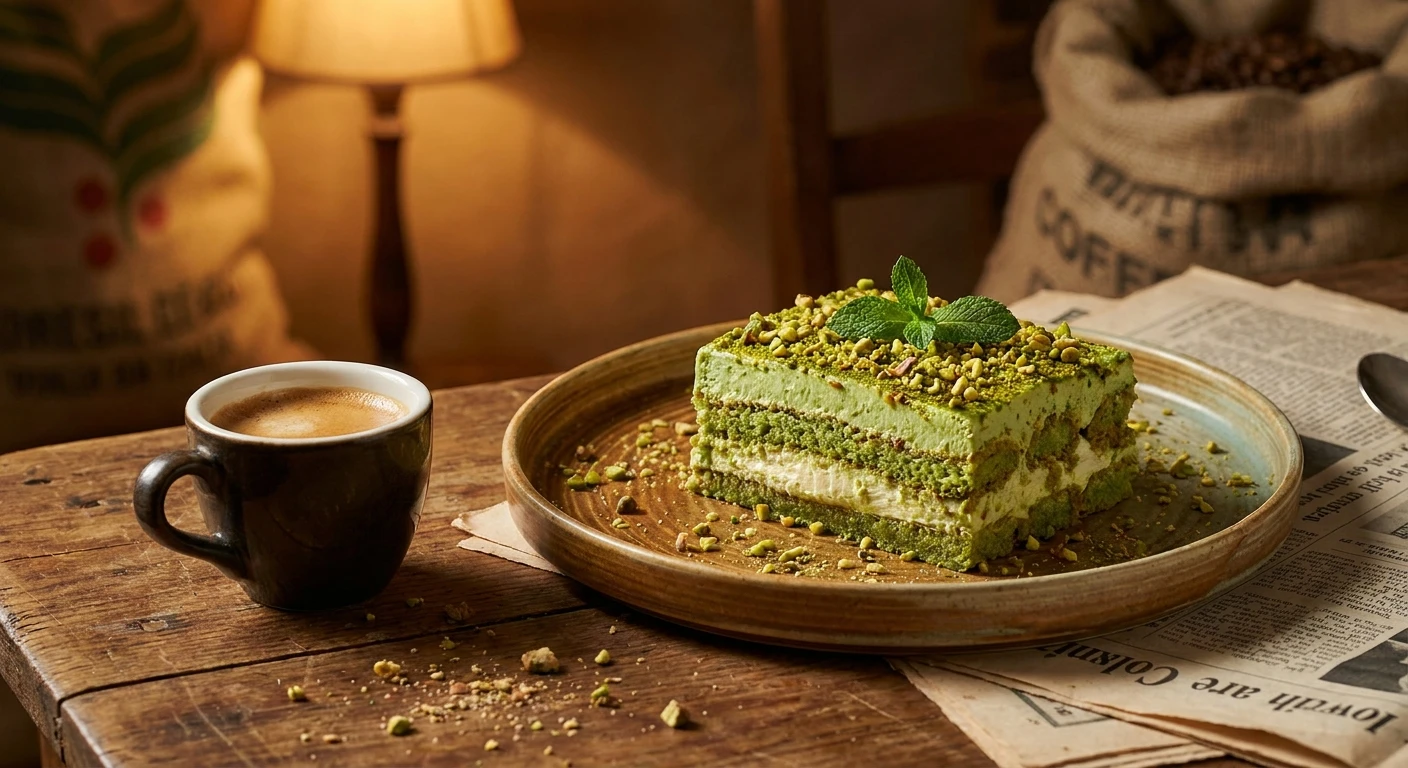
Why I Keep Coming Back to Pistachio Tiramisu
I still remember the exact moment I tasted a proper pistachio tiramisu, and honestly, it completely ruined standard desserts for me. We were sitting in a tiny, tucked-away coffee shop in Kyiv, right near Zoloti Vorota, trying to escape a sudden spring downpour. The barista brought out this brilliant, naturally green slice, dusted with crushed, roasted nuts instead of the usual heavy cocoa powder. I took one bite, and my jaw basically hit the floor. The roasted, earthy richness of the pure nut paste perfectly cut through the sweet, heavy mascarpone cream, while the bitter espresso soaked into the ladyfingers anchored the entire flavor profile. It is simply the ultimate dessert combination, marrying caffeine, creamy dairy, and a savory-sweet nutty finish.
Now that we are well into 2026, it feels like every bakery is trying to make a green dessert, but so many of them get it wrong by using artificial syrups or cheap extracts. The real deal requires pure, unsweetened Sicilian paste. Seriously, if you are tired of the standard chocolate and coffee routine you see at every dinner party, you need to make this. It is a brilliant twist on an Italian classic that will have your friends begging you for the recipe, and once you understand the balance of ingredients, it becomes incredibly easy to throw together for any occasion.
The Core Mechanics of a Nutty Masterpiece
To really appreciate why this dessert works, you have to look at the balance of fats, sugars, and bitterness. Traditional tiramisu relies on the harsh bitterness of espresso and cocoa to balance the heavy, sweet fat of the egg yolk and mascarpone mixture. When you introduce a high-quality nut paste into the equation, you are adding an entirely new dimension of fat—plant-based lipids that carry deep, roasted, earthy notes. This fundamentally shifts the dessert from a simple sweet-and-bitter binary into a complex, savory-adjacent treat.
Consider the value proposition here. By swapping cocoa for nuts, you eliminate the powdery texture that often causes people to choke on their first bite of traditional tiramisu. You also introduce a rich, velvety mouthfeel that only emulsified nut oils can provide. Think about the difference between a standard Californian pistachio and a PDO-certified Bronte pistachio from Sicily. The latter grows in volcanic soil, resulting in a sweeter, more intensely flavored nut with a vibrant green hue that does not require artificial coloring.
| Component | Traditional Style | Pistachio Variation |
|---|---|---|
| Dusting | Dark Cocoa Powder | Crushed Roasted Pistachios |
| Cream Base | Mascarpone & Vanilla | Mascarpone & 100% Pure Nut Paste |
| Flavor Profile | Sweet, Bitter, Chocolaty | Earthy, Creamy, Nutty, Robust |
If you want to pull this off perfectly at home, you have to follow a few non-negotiable rules. Skimping on these will leave you with a runny, overly sweet mess.
- Source 100% pure paste: Check the label. The only ingredient should be pistachios. No sunflower oil, no sugar, no green food dye.
- Control the liquid in your espresso: Do not over-soak the ladyfingers. A quick one-second dip on each side is enough; otherwise, the dessert will weep liquid into the bottom of your dish.
- Respect the chill time: You must let the assembled dessert rest in the fridge for a bare minimum of 12 hours. This gives the starch in the cookies time to absorb the moisture from the cream, creating that sliceable, cake-like texture.
The Origins of the Classic Dessert
Before we can mess with the formula, you have to understand where the original came from. The story of tiramisu is actually surprisingly recent. While many Italian desserts date back centuries, tiramisu as we know it didn’t officially appear on a menu until the late 1960s or early 1970s in Treviso, a city in the Veneto region of Italy. The name translates roughly to “pick me up” or “cheer me up,” a nod to the high sugar and caffeine content. Originally, it was meant as an energy-boosting snack, often given to children or recovering invalids using a simple mixture of beaten egg yolks, sugar, and coffee-soaked biscuits. Eventually, mascarpone was added to give it a richer, more luxurious texture, cementing its status as a staple in Italian dining.
The Evolution of Nutty Flavors
So how did the green nut enter the chat? The evolution happened when southern Italian ingredients started heavily influencing northern Italian techniques. Sicily, particularly the town of Bronte, is famous globally for its “green gold”—pistachios that have a distinctively sweet and robust flavor profile. As chefs began experimenting with regional crossovers in the 1990s and early 2000s, someone had the brilliant idea to fold this precious southern paste into the rich northern mascarpone cream. The result was an instant hit. The natural oils in the nuts complemented the dairy fat perfectly, creating a dessert that felt authentic yet entirely new.
The Modern State of Dessert Menus
Jump forward to today, and you can hardly walk into a specialty cafe or high-end bakery without seeing some variation of this dessert. Social media has played a massive role in popularizing visually striking foods, and the natural pastel green of this dish makes it incredibly photogenic. However, the commercialization has led to a lot of shortcuts. Many chains use artificial flavorings that taste more like almond extract than actual pistachios. That is exactly why making it from scratch at home is so rewarding. You get to control the quality of the ingredients, ensuring that the final product tastes like actual roasted nuts rather than a chemical approximation.
The Chemistry of Mascarpone and Nut Fats
Let’s talk about the science of why this cream is so notoriously finicky to make. Mascarpone is essentially a high-fat cream cheese made by curdling heavy cream with an acid, like lemon juice or citric acid. It typically sits around 70-75% butterfat. When you whip it, you are forcing air into a network of fat globules. If you over-whip it, those fat globules smash together, the emulsion breaks, and you are left with butter and liquid whey. Now, introduce pure nut paste into this delicate system. Pistachios are roughly 45% fat by weight, primarily monounsaturated and polyunsaturated fats. When you fold these liquid plant oils into the solid dairy fats of the mascarpone, you have to do it gently. If you are too aggressive, the differing fat structures will clash, causing the cream to split and look grainy. The trick is to have both the mascarpone and the nut paste at the exact same room temperature before combining them.
Maillard Reaction in Roasted Pistachios
The flavor of the paste is dictated by the Maillard reaction, a chemical process that occurs between amino acids and reducing sugars when the nuts are roasted. This reaction is what creates the complex, savory, roasted flavor compounds that make the dessert taste so good. However, roasting also affects the natural chlorophyll in the nuts, which gives them their green color. Heat degrades chlorophyll into pheophytin, which has an olive-brown hue. This is why high-quality, deeply roasted paste is rarely a bright, neon green.
- Chlorophyll Sensitivity: Natural green colors degrade when exposed to light and heat. Keep your paste in a dark, cool cupboard.
- Emulsion Stability: Egg yolks contain lecithin, a powerful natural emulsifier that helps bind the water in the espresso with the fats in the mascarpone.
- Starch Gelatinization: The ladyfingers (savoiardi) rely on starch networks that swell and absorb liquid without completely dissolving, providing structural integrity.
- Syneresis: If you under-mix the sugar into the egg yolks, the undissolved sugar will draw out water during the chilling process, creating a puddle at the bottom of your dish.
Step 1: Sourcing the Perfect Nut Paste
Your entire dessert hinges on this one ingredient. You need to find a paste that is 100% pure. Look at the nutritional label; there should be no added sugars, no vegetable oils to thin it out, and absolutely no artificial coloring. It will likely be expensive, but it is worth the investment. Before using it, give it a really good stir, as the natural oils will have separated and risen to the top of the jar, much like natural peanut butter.
Step 2: Brewing the Right Espresso
You cannot use weak, watery coffee for this. You need a strong, robust espresso that can stand up against the heavy fats of the cream. Brew about two cups of strong espresso and pour it into a wide, shallow dish to cool completely. Do not dip your biscuits into hot coffee, or they will turn to mush instantly. If you want an extra kick, this is the stage where you can stir in a splash of Amaretto or Frangelico liqueur.
Step 3: Whipping the Egg Yolks and Sugar
In a large glass bowl, combine your extremely fresh egg yolks with granulated sugar. Use an electric mixer on medium-high speed to beat them together until the mixture transforms from a dark yellow liquid into a pale, thick, and creamy foam. This process, called ribboning, should take about four to five minutes. The sugar needs to fully dissolve into the yolks to provide structure to the final cream.
Step 4: Folding in Mascarpone and Paste
Turn your mixer down to the lowest possible speed. Add your room-temperature mascarpone to the egg yolk mixture one large spoonful at a time. Once it is just barely combined, add in your pure nut paste. Stop using the electric mixer at this point. Grab a flexible silicone spatula and gently fold the mixture together by hand. Scrape the bottom and the sides of the bowl to ensure no streaks of plain mascarpone remain, but stop as soon as it is uniform. Do not overmix.
Step 5: The Ladyfinger Dip Technique
This is where most people ruin their tiramisu. Take a crisp ladyfinger (savoiardi biscuit) and dunk it into the cooled espresso. Count “one” as you dip the bottom, flip it quickly, count “two” as you dip the top, and immediately pull it out. The center of the biscuit should still feel slightly hard. It will continue to absorb moisture from the cream as it sits in the fridge. Line the bottom of your serving dish with a tight, even layer of these dipped biscuits.
Step 6: Layering the Dessert
Once you have an even layer of soaked biscuits, spoon exactly half of your prepared green cream over the top. Use an offset spatula to smooth it all the way to the edges, ensuring every biscuit is covered. Now, repeat the dipping process and lay down a second layer of espresso-soaked ladyfingers. Top this with the remaining half of your cream, smoothing the top perfectly flat. Wipe the edges of your dish with a damp paper towel to keep it looking professional.
Step 7: The Overnight Chill
Cover the dish tightly with plastic wrap, ensuring the plastic does not actually touch the surface of the cream. Place it in the refrigerator. Walk away. Do not look at it, do not touch it, and certainly do not try to eat it for at least 12 hours. A full 24 hours is even better. The flavors need this time to meld together, and the biscuits need time to soften perfectly into a cake-like texture. Right before serving, cover the top generously with crushed, roasted pistachios.
Myths vs. Reality in Dessert Making
Myth: You can just use pistachio extract instead of real paste.
Reality: Extract only provides a chemical, highly artificial aroma. It lacks the fat, the texture, and the earthy depth that pure paste provides. Your cream will taste like cheap candy rather than a gourmet dessert.
Myth: You must add green food coloring to make it look authentic.
Reality: High-quality pure paste will naturally tint your mascarpone cream a beautiful, subtle, earthy green. Neon green desserts are a dead giveaway that cheap ingredients and food dyes were heavily used.
Myth: Raw eggs in tiramisu are incredibly dangerous.
Reality: While there is always a minor risk, using fresh, high-quality, pasteurized eggs significantly mitigates this. If you are highly sensitive, you can temper your egg yolks over a double boiler (bain-marie) to safely cook them before whipping.
Myth: You can eat it immediately after making it.
Reality: If you cut into it right away, you will be eating a bowl of soup with hard cookies floating in it. The resting period is scientifically necessary for texture.
Can I freeze this dessert?
Yes, absolutely. Wrap the dish tightly in plastic wrap and then a layer of aluminum foil. It will keep in the freezer for up to a month. Thaw it in the fridge for 24 hours before you plan to serve it.
Do I absolutely need to use raw eggs?
No. If you want to avoid raw eggs entirely, you can substitute the egg yolk mixture with an equal volume of heavy whipping cream, whipped to stiff peaks, and folded into the mascarpone. It will be slightly less rich but still delicious.
How long does it last in the fridge?
It is best consumed within three to four days. After the fourth day, the ladyfingers will start to break down too much, and the dessert will become overly soggy.
What ladyfingers are best?
Always buy the hard, dry, Italian-style savoiardi biscuits. Do not use the soft, spongey cake-like ladyfingers found in some bakery sections; they will turn into mush the second they touch the coffee.
Can I skip the espresso for a caffeine-free version?
Yes. You can dip the biscuits in decaf espresso, or for a completely different flavor profile, you can use a lightly warmed whole milk mixed with a little vanilla extract.
Is this safe for kids to eat?
If you omit the optional alcohol and use pasteurized eggs (or the heavy cream substitute), it is perfectly safe for children. You might want to use decaf coffee so they don’t bounce off the walls.
Why did my cream turn out runny?
You likely either over-mixed the mascarpone, causing the fat structure to break, or you over-soaked your ladyfingers, causing excess coffee to seep into the cream layer. Always fold gently.
Final Thoughts on Your Next Baking Project
Look, stepping away from the standard chocolate dusting and diving into the world of high-quality nut pastes is the best thing you can do for your dessert game. The rich, earthy flavors paired with bitter coffee and sweet cream create an unforgettable experience. Now that you know the science, the history, and the exact steps to avoid a runny mess, you have zero excuses left. Go find yourself a jar of proper Sicilian paste, brew some strong coffee, and get mixing. Trust me, once you serve this pistachio tiramisu to your friends and family, you will never be allowed to show up to a dinner party empty-handed again!
Leave a Reply