

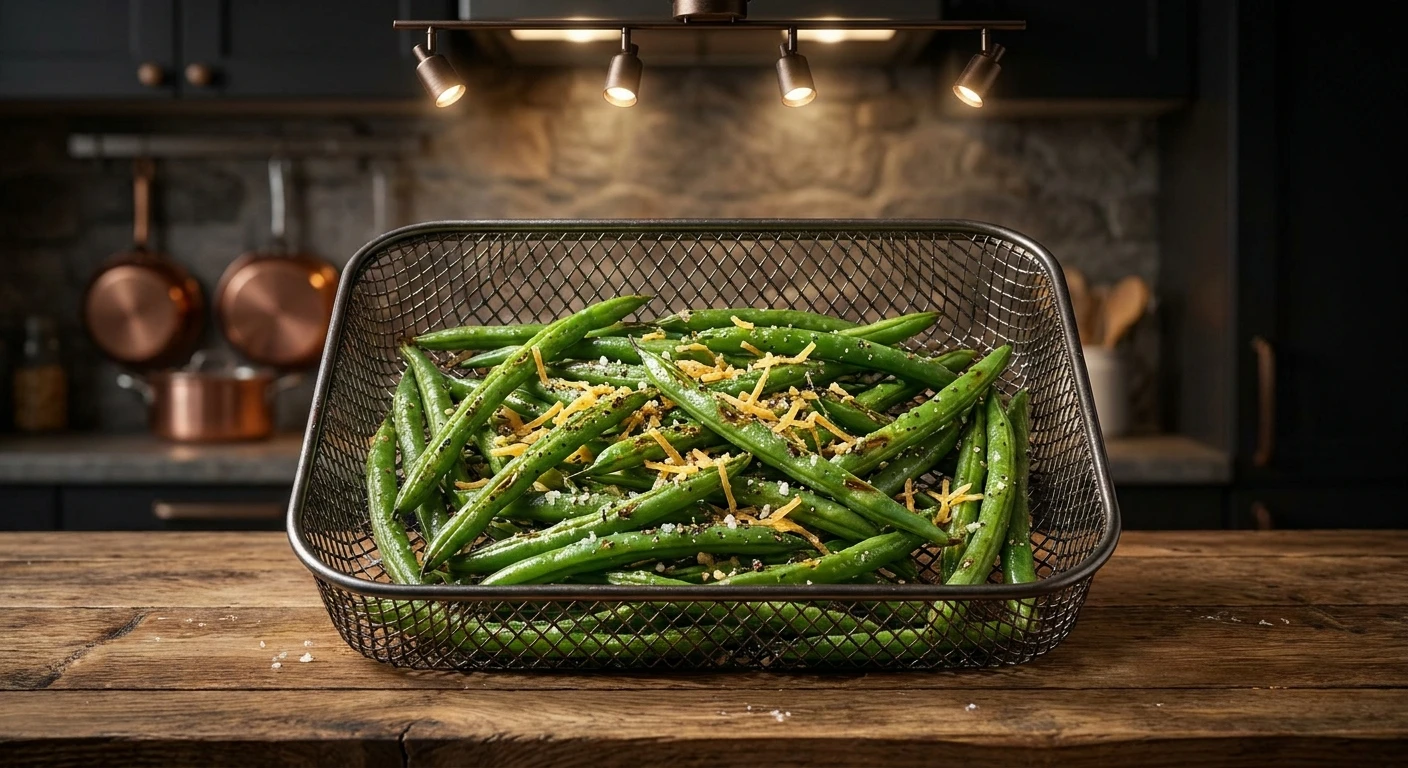
Crispy frozen green beans in air fryer: Your New Favorite Snack
Making frozen green beans in air fryer is literally the easiest way to trick yourself into eating a whole bag of vegetables without even realizing it. Honestly, I used to struggle to get enough greens into my daily meals. Back in Kyiv, my grandmother would spend hours carefully pan-frying fresh garden beans with generous slabs of butter and freshly crushed garlic until they were perfectly blistered, slightly charred, and absolutely irresistible. They were a labor of love. But when I moved into a tiny apartment with a hectic schedule, spending that much time hovering over a hot stove just was not practical anymore. Fresh produce would inevitably wilt in the back of my fridge, tasting like damp cardboard by the time I finally got around to cooking it.
One freezing winter evening, desperate for a taste of home but lacking any fresh ingredients, I grabbed a rock-solid bag of icy veggies from the local Silpo supermarket. I tossed them directly into my countertop convection basket, entirely unsure of what would happen. The result was nothing short of mind-blowing. It perfectly replicated that nostalgic, blistered texture from my childhood without the greasy stovetop mess or the tedious prep work. You absolutely do not need fresh, expensive produce to create a killer side dish; you just need the right temperature, a quick splash of oil, and a handful of basic spices to turn icy, forgotten vegetables into a savory, crunchy masterpiece. I am going to walk you through exactly why this specific cooking method beats boiling, microwaving, or oven-roasting any day of the week, and how you can replicate this flawless crunch every single time you crave something salty and green.
Why This specific Method Changes Everything
Why do we even bother relying on this particular high-speed convection appliance? Think about your typical weekday routine. You drag yourself home, completely exhausted from a long day at the office, and your energy levels are entirely depleted. You desperately want something nutritious to feed your body, but the idea of preheating a massive oven or waiting for a giant pot of water to boil sounds like absolute torture. This is where this technique becomes a total lifesaver.
Let me give you a couple of real-world scenarios. First, imagine you have hungry kids who are practically screaming for fast-food french fries. You can toss these icy green sticks into the basket, press a couple of buttons, and less than ten minutes later, they are happily munching on a healthy green vegetable that genuinely crunches and tastes like a salty potato fry. Second, think about your heavy meal prep Sundays. You desperately need a quick, vibrant side dish to pair with your roasted chicken breasts, but every single burner on your stovetop is already occupied with sauces and soups. Boom—your countertop gadget steps up and effortlessly handles the side dish while you focus on the main course.
| Cooking Method | Average Time Required | Resulting Texture & Taste |
|---|---|---|
| Standard Microwave | 5 to 7 Minutes | Incredibly soggy, limp, and totally unappetizing |
| Traditional Oven Roasting | 25 to 30 Minutes | Decent crunch, but highly uneven cooking and massive energy waste |
| High-Speed Air Frying | 10 to 12 Minutes | Perfectly blistered, uniformly crispy, and restaurant-quality |
To master this, you only need to follow a few core, non-negotiable rules:
- Do not thaw under any circumstances: Seriously, throwing the vegetables into the basket straight from the deep freeze is the ultimate magic trick. If you let them sit on the counter and thaw, they release all their internal water and instantly turn to absolute mush.
- Strategic oil application: You must spray or gently toss them with just one single teaspoon of high-quality olive or avocado oil. This tiny amount of lipid is completely necessary so your chosen seasonings actually stick to the skin rather than falling through the grates.
- The mandatory mid-cook shake: You absolutely must pull the basket out and give it a vigorous shake right at the five-minute mark. This ensures the rapidly circulating heat hits every single angle of the vegetable, guaranteeing an even, golden blister.
Origins of the Humble Green Bean
To truly appreciate what we are cooking, we have to look back at the origins of the vegetable itself. Green beans, scientifically known as Phaseolus vulgaris, have been cultivated by human beings for literally thousands of years. Originating primarily in Central and South America, these incredibly resilient legumes were a staple for ancient indigenous populations long before they ever made their way across the ocean to Europe. Native farmers understood their immense nutritional value and agricultural reliability. They planted them alongside corn and squash in a genius symbiotic farming method known as the “Three Sisters,” where the bean vines would naturally climb the tall corn stalks, fixing vital nitrogen into the soil for the other plants to thrive.
The Evolution of Flash-Freezing Technology
For centuries, if you wanted to preserve these beans for the harsh winter months, your only real option was to aggressively salt or can them, which completely destroyed their beautiful crunch and vibrant color, turning them into a dull, olive-green mush. Everything changed in the 1920s when an innovator named Clarence Birdseye observed the Inuit people in the Arctic preserving fish by instantly freezing it in the incredibly frigid wind. He realized that rapidly freezing food at ultra-low temperatures prevented the formation of massive, destructive ice crystals. By applying this exact flash-freezing technique to freshly picked green beans right at the peak of their summer ripeness, the agricultural industry figured out how to perfectly lock in the cellular structure, the bright green chlorophyll, and all the essential vitamins.
The Modern State of High-Speed Convection
Fast forward to the year 2026. The culinary landscape has shifted entirely. Almost every modern kitchen across the globe now features a high-speed convection machine sitting proudly on the countertop. We have collectively moved away from dangerous, messy vats of boiling deep-fryer oil toward health-conscious, rapid-air technology. These modern machines utilize an incredibly powerful heating element paired with a heavy-duty mechanical fan to aggressively circulate scorching hot air around the food at breakneck speeds. This specific engineering marvel is exactly what allows us to take a rock-hard, frozen agricultural product and transform it into a perfectly roasted delicacy in mere minutes.
The Magic of the Maillard Reaction
If you really want to understand why this cooking technique yields such incredibly delicious results, we need to talk about food science, specifically the Maillard reaction. This is the complex chemical reaction between amino acids and reducing sugars that gives browned food its incredibly distinctive, savory flavor. Normally, achieving a proper Maillard reaction requires an exceptionally dry cooking environment and temperatures exceeding 285°F (140°C). When you toss an icy vegetable into a regular oven, it slowly melts, sitting in a puddle of its own water, essentially steaming itself. But the aggressive, circulating fan in our modern countertop gadget violently strips away that moisture the absolute second it melts, allowing the surface temperature of the skin to spike rapidly, triggering that beautiful, savory browning process even though the core of the vegetable started at zero degrees.
Sublimation and Moisture Control
Another fascinating scientific principle at play here is a concept closely related to sublimation and rapid evaporation. Because the environment inside the basket is so highly pressurized with dry heat, the surface ice on the vegetables converts to steam and is instantly vented out of the machine. This aggressive moisture control is the solitary reason your side dish ends up crunchy instead of soggy.
- Rapid moisture evaporation: High-speed internal fans aggressively strip the boundary layer of steam away from the food’s surface the exact millisecond it forms, keeping the cooking environment completely arid.
- Cellular wall integrity: Because commercial facilities flash-freeze the produce at temperatures well below -20°F, large, jagged ice crystals never get the chance to form and rupture the plant’s delicate pectin walls, ensuring the internal texture remains remarkably firm.
- Exceptional caloric efficiency: This high-velocity air method allows home cooks to achieve a beautifully crispy, deeply browned crust with up to ninety percent less lipid absorption compared to traditional deep fat frying, making it an incredibly macro-friendly option.
Step 1: Secure the Right Cut
The journey to the ultimate crunch begins in the grocery store aisle. You must specifically look for whole string beans or “haricots verts” (the thinner, French variety). Do not buy the “French-cut” or diagonally sliced versions, as those are far too thin and will instantly disintegrate and burn into bitter ashes under the intense, rapidly circulating heat. You want the whole, intact pod to ensure it holds up to the intense temperature.
Step 2: The Preheat Ritual
Do not skip this phase. You need to set your machine to exactly 380°F (190°C) and let it run completely empty for a full three minutes. Preheating ensures that the absolute second the icy vegetables hit the metal grate, the cooking process begins instantly, shocking the exterior into a rapid crisp rather than letting them slowly warm up and become a soggy, pathetic mess.
Step 3: The Unthawed Dump
Take the bag directly out of your freezer and immediately dump the contents straight into the preheated, screaming-hot basket. Do not rinse them. Do not let them sit on your kitchen counter while you prep other ingredients. Any exposure to room temperature will cause the internal ice to begin melting, which is the absolute sworn enemy of a good, satisfying crunch.
Step 4: The Oil Misting
While they are sitting in the hot basket, you need to apply a very light binder. I highly recommend using a non-aerosol misting bottle filled with pure avocado oil, as it has a brilliant high smoke point. Give them three or four quick sprays. You are not trying to drown them; you just want a microscopic layer of fat to help conduct the heat and grab onto the spices.
Step 5: The Flavor Dusting
Now is the time to aggressively season. Generously sprinkle a heavy pinch of coarse kosher salt, freshly cracked black pepper, and a heavy-handed dash of fine garlic powder directly over the oiled pods. The garlic powder will actually toast in the circulating heat, developing a deeply sweet, roasted, aromatic profile that completely masks any bitter green notes.
Step 6: The Halfway Toss
Set your timer for a total of ten minutes. Right at the exact five-minute mark, you must pull the drawer completely out and aggressively shake it like you are mixing a cocktail. This violently redistributes the vegetables, ensuring the ones buried at the bottom get their fair turn at the top near the glowing red heating element for maximum crispiness.
Step 7: The Finishing Touch
When the ten minutes are up, pull the drawer out. The pods should look wrinkled, blistered, and dotted with dark, charred spots. Immediately transfer them to a serving bowl while they are still scorching hot and squeeze half of a fresh lemon over the top, or generously grate fresh, salty Parmigiano-Reggiano cheese over them. The residual heat will melt the cheese instantly into a savory crust.
Myths vs. Reality of Freezer-Aisle Veggies
Myth: Buying frozen vegetables means you are actively choosing a product that is significantly less nutritious than the beautiful, fresh produce sitting in the brightly lit section of the grocery store.
Reality: This could not be further from the truth. Commercial vegetables are harvested at their absolute peak nutritional ripeness and blast-frozen within mere hours. Fresh produce often spends days or even weeks sitting on delivery trucks and supermarket shelves, slowly degrading and losing vital water-soluble vitamins every single day.
Myth: You absolutely must thaw them out and pat them completely dry with paper towels before you attempt to roast them, otherwise they will be a soggy disaster.
Reality: Thawing is a fatal error that completely destroys the cellular integrity of the plant, turning it to complete mush. Hitting them with intense, dry heat while they are totally solid forces the ice to bypass the water stage and turn straight into steam, ensuring a phenomenally crunchy exterior.
Myth: Because you are using a convection machine, you do not need to use a single drop of oil.
Reality: While you absolutely avoid deep-frying, a tiny, microscopic mist of oil is biologically and chemically necessary to properly conduct the intense heat and allow your dry spices to physically bind to the smooth skin of the vegetable.
Can I use fresh produce instead of icy ones?
Yes, absolutely. If you happen to have a fresh batch from the farmer’s market, you can use this exact same method. However, because they lack the dense, internal ice, you need to reduce the total cooking time by about two to three minutes to prevent them from burning to a crisp.
What exact temperature yields the best results?
After endless testing, 380°F (190°C) is the absolute undisputed sweet spot. It is hot enough to aggressively trigger the browning reaction on the skin, but just gentle enough that the tender inside of the pod doesn’t turn into powdery ash before the ice fully evaporates.
Do I need to put down parchment paper or foil?
No, please do not do this. Putting down any kind of solid liner completely blocks the crucial airflow coming from the bottom grates. The entire mechanism relies on 360-degree air circulation to pull the moisture away. Block the air, and you get soggy food.
How long do leftovers last in the refrigerator?
They will keep safely for up to three days if stored properly in an airtight glass container. However, they will completely lose their magical crunch in the fridge. To revive them, do not microwave them; simply toss them back into the machine at 350°F for about three minutes.
Can I throw in some bacon bits for extra flavor?
Absolutely, that is a phenomenal idea. Because bacon cooks incredibly fast under high convection, you should only toss the crumbled bits into the basket during the final three minutes of the cooking cycle so they render their fat without burning.
Why did my batch turn out super rubbery and tough?
You almost certainly overcrowded the metal basket. If you dump an enormous, towering mountain of icy vegetables into the drawer, the steam gets trapped in the center of the pile. They end up sadly steaming each other rather than roasting. Always cook in single-layer batches.
Is this recipe compatible with a strict keto diet?
One hundred percent yes. These legumes are naturally incredibly low in net carbohydrates and extraordinarily high in dietary fiber. Paired with a healthy fat like avocado oil, they fit perfectly into a ketogenic, low-carb lifestyle.
Ultimately, completely mastering this incredibly simple technique will totally revolutionize your chaotic weeknight dinner routine. Stop dreading vegetable prep and start embracing the power of modern kitchen technology. Go grab a bag from your freezer right now, fire up your machine, and experience the glorious crunch for yourself!
Leave a Reply