
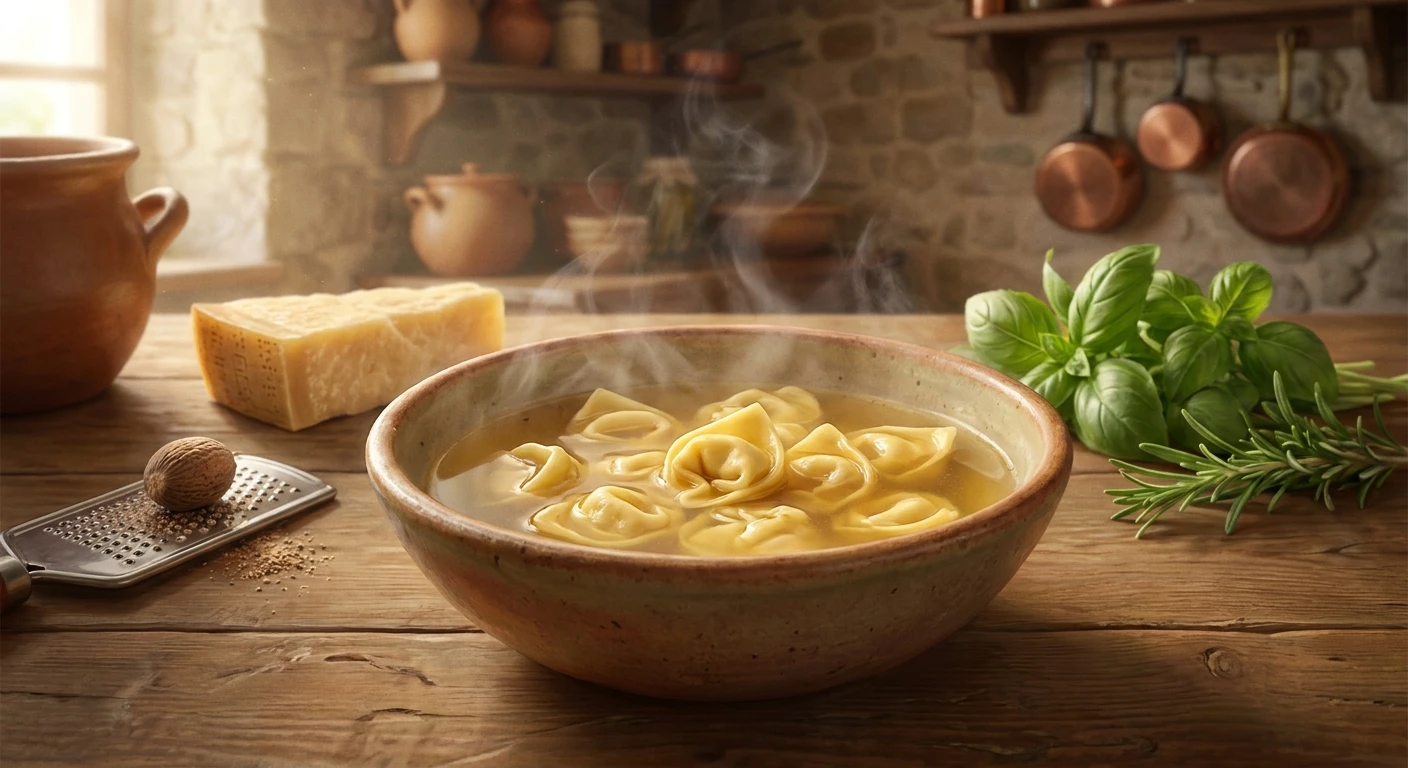
The Ultimate Guide to Perfect tortellini in brodo
If you want to know what a real, physical hug in a bowl feels like, you need to make tortellini in brodo right away. It is incredibly funny how a simple, classic Italian dish connects so deeply with my own Ukrainian soul. Just last winter, the power went out in Kyiv for a solid twelve hours. It was freezing, pitch black, and honestly, a bit miserable as the cold draft crept through the windows. My grandmother used to make rich chicken bouillon to warm us up, but I happened to have a fresh batch of tiny handmade pasta waiting in the fridge. I lit the small camping gas stove, simmered the rich golden broth, and dropped in those little meat-filled rings. The savory aroma instantly filled the freezing kitchen, pushing away the gloom. That steaming bowl absolutely saved the night, bringing warmth and comfort when we needed it most.
This dish isn’t just a basic soup; it is a profound culinary experience built entirely on patience, technique, and high-quality ingredients. We are taking broth to an entirely new level of flavor. My thesis for you is simple: when you combine a slow-simmered capon or beef bone broth with expertly folded, paper-thin egg dough stuffed with premium cured meats, you create a masterpiece that defies basic cooking rules. You absolutely don’t need fancy restaurant equipment, just good, honest ingredients and a little bit of love. Let me walk you through exactly how you can master this comforting, soul-warming classic right in your own home kitchen. It is entirely worth the effort, and you will taste the dedication in every single spoonful.
Why should you spend hours making tortellini in brodo from scratch when you can just buy canned soup or pre-made pasta at the grocery store? The value proposition is all about texture, authentic flavor, and the beautiful layering of savory elements. When you make it yourself, you completely control the umami explosion that happens in your mouth. Let me give you a couple of concrete examples. Example one: commercial broth often tastes incredibly flat, heavily salted, and artificial. By contrast, a homemade bone broth extracts natural collagen over several hours, creating a silky mouthfeel that coats your tongue perfectly, making the dish feel luxurious. Example two: store-bought tortellini get mushy the second they hit hot water and usually lose their filling entirely. Handmade pasta, however, retains a beautiful al dente bite, keeping the rich pork and prosciutto filling intact until the exact moment you bite into it.
Let’s break down the core components you need to get absolutely right to pull this off.
| Component | Purpose in the Dish | Quality Standard Required |
|---|---|---|
| The Broth (Brodo) | Provides the rich, liquid base, deep umami flavor, and physical warmth. | Must be crystal clear, deeply golden, and gelatinous when cold. |
| The Pasta Dough | Encases the savory filling with a delicate, satisfying chew. | Paper-thin, rich yellow color from high-quality fresh eggs. |
| The Filling (Pesto) | Delivers a salty, savory umami punch that balances the broth. | Properly cured meats, aged Parmigiano-Reggiano, and a hint of nutmeg. |
To nail this recipe, you must follow these absolute non-negotiables during the process:
- Never boil the broth vigorously. You must keep it at a bare, lazy simmer. Boiling emulsifies the fats and impurities into the liquid, resulting in a cloudy, greasy mess instead of the pristine, clear golden elixir we want.
- Roll the dough until you can literally see your fingers through it. Thick pasta will overwhelm the delicate filling and completely throw off the meat-to-carb ratio. You want the pasta to melt in your mouth alongside the savory meat.
- Use authentic Parmigiano-Reggiano. Do not substitute this with cheap, pre-grated cheese. The rind goes into the broth for extra flavor, and the freshly grated cheese binds the filling together, providing that essential nutty flavor profile.
Mastering these specific elements means you will never look at soup the same way again. The stunning clarity of the slow-cooked broth combined with the rich, savory meat pockets creates a flawless harmony that leaves everyone at the table asking for seconds.
The Mystical Origins of the Ring
The story behind tortellini in brodo is wrapped up in charming, slightly cheeky Italian folklore. Legend says the iconic shape of the tortellini was inspired by the navel of Venus, the Roman goddess of love. Supposedly, an innkeeper in the town of Castelfranco Emilia peeked through a keyhole, caught a glimpse of the goddess’s navel, and rushed back to his kitchen to passionately recreate it in fresh pasta dough. While that sounds incredibly romantic and fun to share at dinner parties, the practical reality is much more functional. Cooks needed a secure, efficient way to fold pasta so the precious, expensive meat filling wouldn’t burst out during the cooking process. By tightly wrapping the dough into a sealed ring, the edges are locked securely, trapping all the juices and flavors inside. Serving it in hot broth was simply the most nourishing and warming way to consume it during the harsh, damp, foggy winters of the Emilia-Romagna region.
Evolution Through the Centuries
Initially, meat was an extreme luxury reserved for the upper class. Only the wealthy nobility could afford cuts of pork loin, prosciutto crudo, and mortadella for their daily pasta fillings. In the medieval and Renaissance eras, tortellini in brodo became a powerful symbol of prosperity and celebration. It was served almost exclusively on Christmas Day and other major holidays to celebrate the harvest and the winter slaughter. As time passed and ingredients became more accessible, the recipe became a beloved staple for the middle class, but the dedication to high-quality ingredients never wavered. The original recipe was so fiercely guarded by locals that a specific, formalized recipe was actually deposited and registered with the Chamber of Commerce in Bologna in 1974. They did this to ensure nobody messed with the traditional ratios and that the heritage remained intact for future generations.
The Modern State of the Dish
Here in 2026, the culinary landscape moves incredibly fast, with viral food trends coming and going daily. Yet, this dish remains an untouchable, rock-solid anchor of Italian tradition. While you might occasionally see trendy fusion chefs throwing tortellini into heavy cream sauces, deep-frying them, or stuffing them with wild ingredients, true purists know that cooking and serving them in brodo is the only true way to honor the craft. Modern home cooks now have access to better temperature control, induction stoves, and high-quality imported ingredients shipped directly to their doors. This makes it easier than ever to replicate the authentic Bolognese experience at home. The dish stands as a delicious rebellion against fast food, forcing us to slow down, appreciate the artisanal craft, and enjoy the pure, unadulterated flavors of slow-cooked meat and handmade pasta.
The Science of Gelatin Extraction
Why does a proper brodo feel so completely different in your mouth compared to regular water or cheap bouillon? It all comes down to the fascinating science of collagen extraction. When you slowly simmer bones—specifically cuts with high amounts of connective tissue like beef joints, oxtail, or chicken wings—the prolonged heat and time cause the tough collagen proteins to break down and convert into gelatin. This gelatin slowly dissolves into the water. If you heat the water too aggressively and let it boil hard, you risk violently churning the fat and impurities into the liquid, making it hopelessly cloudy. We call this a colloidal suspension. By maintaining a gentle, bubbling simmer, you allow the gelatin to enrich the water without clouding it. The result is a viscous liquid that literally coats your palate, amplifying the savory flavor compounds and making every single spoonful taste richer, heavier, and far more satisfying than regular soup.
Osmosis and Pasta Hydration
When you drop the fresh, raw tortellini into the hot broth, a beautiful and complex physical reaction occurs instantly. The fresh pasta dough undergoes rapid hydration and starch gelatinization. The heat causes the tight starch granules in the ’00’ flour to swell and absorb the surrounding liquid. Because they are cooking in broth and not plain water, the pasta is literally pulling the flavor of the meat stock into its very structure through osmosis.
Here are some fascinating scientific facts about cooking this specific dish:
- Maillard Reaction: Roasting your beef bones before making the broth triggers this complex chemical reaction, browning the amino acids and sugars to create hundreds of new, complex flavor compounds that make the broth taste roasted and deep.
- Isotonic Balance: The salt level in the broth must closely match the salt level in the meat filling. If the broth is too fresh (unsalted), osmosis will actively pull the salt out of the meat filling, leaving the tortellini tasting completely bland.
- Enzymatic Breakdown: The long aging process of the Parmigiano-Reggiano used in the filling breaks down milk proteins into free amino acids, particularly glutamate, which acts as a massive, natural flavor enhancer (umami) for the pork.
- Protein Coagulation: The egg proteins in the pasta dough coagulate firmly between 140°F and 160°F, turning the soft, stretchy dough into a firm, elastic barrier that perfectly locks the meat juices inside.
You might think this all sounds incredibly complicated and takes way too much time, but breaking it down into distinct phases makes it surprisingly easy to manage. Here is your foolproof, step-by-step masterclass to pulling off the perfect bowl of comfort.
Step 1: Procure the Right Bones
Your broth is the absolute foundation of the meal. Source a good mix of beef bones (look for marrow and knuckle joints) and a whole free-range chicken or capon. Do not skimp on quality here; the quality of your meat directly dictates the success of the entire dish.
Step 2: The Slow, Lazy Simmer
Place your meats in a massive stockpot and cover them completely with cold water. Bring it up to a very lazy simmer over medium-low heat. Skim the gray foam and scum off the top religiously for the first hour. Add your aromatics—celery, carrots, unpeeled onions, and a few black peppercorns. Let this ride for at least 6 to 8 hours.
Step 3: Clarify and Strain
Once the broth is deeply golden and tastes intensely rich, strain it carefully through a fine-mesh sieve lined with damp cheesecloth. Do not press or squeeze the vegetables or meat, just let gravity do the work to keep the broth perfectly clear.
Step 4: Mix the Meat Filling
Finely mince equal parts pork loin (briefly browned in butter), prosciutto crudo, and high-quality Mortadella di Bologna. Blend this meaty mixture with a generous handful of freshly grated Parmigiano-Reggiano, one whole egg, and a fresh grating of nutmeg. It should form a smooth, cohesive paste.
Step 5: Roll the Egg Dough
Create a well on your counter with ’00’ flour and crack fresh, room-temperature eggs into the center. Knead the dough vigorously until it feels like smooth, supple leather. Wrap it tightly in plastic and let it rest for thirty minutes to relax the gluten network. Roll it out into paper-thin sheets using a machine or rolling pin.
Step 6: Cut, Stuff, and Fold
Cut the pasta sheets into tiny, uniform squares (about one inch wide). Place a pea-sized amount of filling directly in the center. Fold it diagonally into a triangle, seal the edges tightly, then wrap the two bottom corners around your pinky finger, pressing them together to form the iconic ring shape.
Step 7: Cook and Serve
Bring your beautiful, clear broth to a gentle, rolling boil. Drop the fresh tortellini straight in. Because they are fresh, they only take about two to three minutes to cook. Serve immediately in warm bowls, ladling the fragrant broth generously over the top, and finish with a heavy, snowy dusting of extra Parmigiano-Reggiano.
Let’s clear up some common misconceptions and myths about this beloved classic so you don’t make rookie mistakes.
Myth: You can cook the tortellini in plain boiling water and just pour hot broth over them in the serving bowl to save the broth from getting cloudy.
Reality: You absolutely must cook the pasta directly in the broth. The starch released from the pasta slightly thickens the broth in a pleasant way, and the pasta absorbs the savory stock instead of bland water, unifying the entire dish.
Myth: Tortellini in brodo is a quick weeknight dinner you can throw together after work.
Reality: This is a true labor of love that takes two days to do properly. The broth needs hours of simmering and preferably a night in the fridge to easily remove the fat cap, while the pasta requires careful, repetitive hand-folding.
Myth: Any ground meat works perfectly fine for the filling.
Reality: Authentic recipes specifically demand a strict ratio of pork loin, prosciutto, and mortadella. Using ground beef or chicken completely changes the intended flavor profile, salt balance, and texture.
Myth: You should add garlic and lots of herbs to the broth for more flavor.
Reality: Traditional Bolognese brodo relies solely on the meat, celery, carrot, and onion. Garlic is too aggressive and easily overpowers the delicate harmony of the dish.
Can I freeze the raw tortellini?
Absolutely. Freeze them in a single layer on a flat tray first so they don’t stick, then transfer them to an airtight freezer bag. Cook them directly from frozen, adding an extra minute to the cooking time.
How long does the fresh broth last?
It stays wonderfully fresh in the fridge for about four to five days, or you can freeze it in airtight containers for up to six months.
Can I use store-bought boxed broth?
You technically can, but it honestly defeats the purpose of the recipe. The homemade, gelatin-rich brodo is fully half of the entire experience.
Why did my tortellini open up while cooking?
You likely didn’t press and seal the edges tightly enough, or the pasta dough dried out too much before you folded them. Keep the waiting dough covered with a damp towel.
What flour is definitively best for the dough?
Type ’00’ flour is the absolute gold standard for achieving silky, highly workable egg pasta that rolls out ultra-thin.
Can I skip the nutmeg if I don’t like it?
Nutmeg is an absolute necessity in authentic Emilia-Romagna cuisine; it cuts through the rich fat of the pork and cheese perfectly. Just use a tiny pinch!
How many tortellini make a proper portion?
Traditionally, a generous, satisfying portion includes about 20 to 25 small tortellini per person, swimming in plenty of broth.
In the end, dedicating your weekend to crafting this magnificent dish is a profound way to show someone you deeply care about them. The hours spent patiently simmering bones and meticulously folding tiny pasta rings yield a bowl of pure, unadulterated comfort that transcends generations and trends. It remains a legendary culinary staple, even now in 2026. Grab your finest ingredients, clear your Sunday afternoon schedule, and start your broth! Share this comprehensive guide with your favorite cooking partner, roll up your sleeves, and start making some unforgettable culinary memories today.
Leave a Reply