

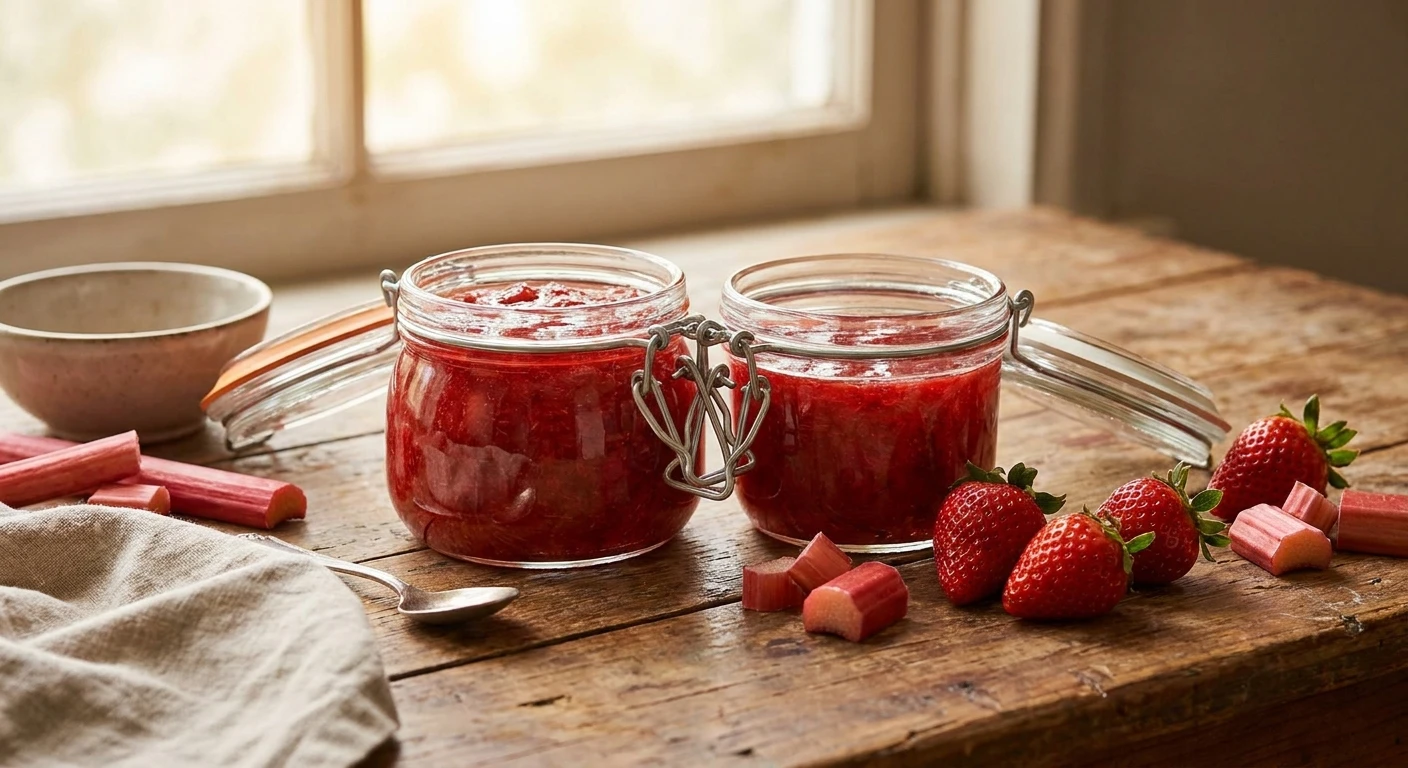
Delicious Strawberry Rhubarb Freezer Jam
There is absolutely nothing like popping open a fresh jar of strawberry rhubarb freezer jam on a cold morning to instantly bring back the bright, vibrant taste of summer. You get that perfect, mouth-watering balance of sweet, juicy berries and the signature sharp tang of fresh rhubarb, all without ever having to turn on the stove. This method skips the exhausting boiling and water-bath processing completely. Instead, it relies on simple natural chemistry to set the fruit into a luscious spread that maintains its raw, garden-fresh flavor profile.
If you have ever felt intimidated by traditional canning methods, you are definitely not alone. Sterilizing jars and monitoring boiling water temperatures can feel like an entire weekend project. By shifting to the freezer method, you essentially hack the preservation process. The fruit is chopped, mixed with sugar and a special pectin, and allowed to set at room temperature before heading straight into the cold. This keeps the delicate cellular structure of the strawberries intact. It also leaves the tart rhubarb crisp and bright.
Read also: Best slow cooker butter chicken with jar sauce; Perfect Rum and Cranberry Juice Mix.
You can use this vibrant spread on toast, swirl it into your morning yogurt, or warm it slightly to pour over vanilla bean ice cream. The sheer versatility is what makes this a staple recipe to keep on hand. Once you taste the difference between fruit that has been boiled for hours versus fruit preserved raw, you will never want to go back to the old way of doing things.
Why This Jam Protocol Beats Traditional Canning
Making preserves at home should be a fast, highly rewarding process. The primary value proposition of the freezer method centers around heat—or rather, the total lack of it. When you boil fruit for traditional canning, you inevitably alter its molecular structure and flavor. Heat breaks down the volatile organic compounds that give strawberries their fresh, floral aroma. By skipping the cooking phase, you lock in the exact flavor the fruit had the moment it was picked. Two quick examples of how this benefits your daily routine: first, a busy parent can whip up a year’s supply of jam in just under forty-five minutes on a Tuesday evening. Second, bakers can rely on this spread as a bright, highly concentrated fruit filling for fresh tarts or cake layers without the dull, muted taste often found in cooked jams.
To fully grasp the advantages, here are the core reasons why this specific method dominates modern home food preservation:
- Maximum Flavor Retention: Without the destructive presence of boiling temperatures, the fruit retains 100% of its fresh, raw taste profile.
- Time and Energy Efficiency: You completely eliminate the need for specialized canning equipment, hot water baths, and hours spent sweating in a humid kitchen.
- Nutritional Preservation: Heat-sensitive vitamins, particularly Vitamin C, are highly unstable and degrade rapidly when boiled, but freezing preserves them almost entirely.
| Jam Type | Flavor Profile | Preparation Time |
|---|---|---|
| Freezer Jam | Bright, raw, highly aromatic | Under 45 minutes |
| Traditional Canned | Cooked, caramelized, slightly muted | 2 to 4 hours |
| Commercial Store-bought | Overly sweet, artificial undertones | 0 minutes (purchased) |
By understanding these basic metrics, it becomes incredibly clear why avoiding the stovetop is the smartest route for optimal taste and texture. You end up with a product that genuinely tastes like a bowl of freshly chopped fruit.
The Origins of Fruit Preservation
The human necessity to store fruit for the barren winter months dates back thousands of years, long before commercial refrigeration existed. Early civilizations relied on honey or heavy sugar syrups to create an inhospitable environment for bacterial growth. They would pack raw fruits into clay vessels, burying them in root cellars where the naturally cool earth slowed down fermentation. Rhubarb, originally cultivated for medicinal purposes in Asia, eventually made its way to Europe, where resourceful cooks discovered that its intense tartness perfectly balanced the overpowering sweetness of early fruit preserves.
The Evolution of Freezer Jams
The true shift in how we approach this task happened in the early 20th century with the commercial isolation and production of fruit pectin. Before this, cooks had to rely entirely on the naturally occurring pectin in the fruits themselves, which required extended boiling times to activate and evaporate enough water to force a gel. When scientists figured out how to extract pectin from citrus peels and apples, they created a powder that could do the heavy lifting. Eventually, specialized formulas were developed specifically to react with sugar at room temperature. This completely eliminated the need for heat, giving birth to the modern no-cook jam movement that prioritized speed and fresh taste over shelf stability at room temperature.
The Modern State of Home Preserving
Now, as we navigate through 2026, efficiency and food quality are paramount. People simply do not have the time to dedicate an entire weekend to monitoring pressure canners, yet they still crave high-quality, additive-free foods. The current landscape of home preserving heavily favors freezer methods because they align perfectly with modern kitchen habits. We have access to highly reliable, energy-efficient chest freezers and advanced pectin blends that guarantee a perfect set every single time. The focus has completely shifted from mere survival preservation to culinary optimization, ensuring that every spoonful delivers the maximum amount of flavor possible.
The Chemistry of Cold Pectin
If you want to master this process, you need to understand the basic mechanics happening inside the bowl. Traditional pectin requires high heat and a very specific acidic environment to dissolve and form a three-dimensional gel network. However, freezer jam relies on a modified type of pectin, typically a low-methoxyl or a specifically formulated instant pectin. These specialized powders are engineered to bypass the thermal requirement. Instead of heat, they rely purely on the mechanical friction of stirring, the precise ratio of dissolved sugar, and the natural moisture of the macerated fruit to create bonds. When you stir the sugar and pectin into the crushed strawberries and rhubarb, the sugar essentially pulls water away from the pectin molecules. This forces the pectin strands to bump into each other, intertwine, and create a microscopic mesh that traps the fruit juices, transforming a watery puree into a firm, spreadable solid.
Enzymatic Activity and Flavor Retention
The secondary scientific benefit of this cold process involves volatile organic compounds. Strawberries owe their distinct aroma to a complex matrix of esters, aldehydes, and ketones. These aromatic compounds are notoriously fragile. When subjected to temperatures exceeding 140°F (60°C), they rapidly vaporize and escape into the air. This is why a kitchen smells amazing when boiling jam, but the jam itself often ends up tasting flat.
- pH Requirements: The mixture must generally maintain a pH level between 2.8 and 3.6 to allow the pectin bonds to solidify efficiently without heat.
- Freezing Point Depression: The high concentration of dissolved sucrose physically lowers the freezing point of the water in the fruit, preventing the jam from turning into a rock-hard block of ice in the freezer.
- Enzyme Preservation: Naturally occurring enzymes in the raw rhubarb remain active, contributing to the distinct, fresh snap and tartness that cooked rhubarb loses completely.
- Osmotic Pressure: Sugar acts as a preservative by creating high osmotic pressure, drawing moisture out of any potential microbial cells and inhibiting their growth.
Step 1: Selecting the Perfect Produce
Your end result will only ever be as good as the raw ingredients you start with. Choose strawberries that are deeply red all the way through, avoiding any with white shoulders or mushy spots. For the rhubarb, look for firm, crisp stalks. The color of the rhubarb does not affect the flavor, but selecting bright pink or red stalks will give your final spread a much more visually appealing, vibrant hue.
Step 2: Precision Chopping and Maceration
Because we are not boiling the fruit to break it down, your knife work is critical. Dice the rhubarb stalks into very fine, uniform pieces—no larger than a quarter of an inch. If the pieces are too large, they will be unpleasantly crunchy. Hull and crush the strawberries using a potato masher. You want a mix of juice and small fruit chunks. Combine the two in a large glass or stainless-steel bowl.
Step 3: Activating the Pectin
Read your specific pectin package instructions carefully, as instant or freezer pectins differ slightly by brand. Typically, you need to whisk the dry pectin powder directly into the granulated sugar before adding it to the fruit. Mixing the powder thoroughly into the sugar prevents the pectin from clumping together into gummy, undissolvable balls when it hits the liquid fruit juice.
Step 4: The Crucial Sugar Blend
Do not drastically reduce the sugar unless you are using a pectin explicitly designed for low-sugar recipes. The sugar is not just there for sweetness; it is a structural necessity. It binds with the free water in the crushed fruit, allowing the pectin network to form properly. Pour the well-mixed sugar and pectin blend over the prepared strawberries and rhubarb.
Step 5: Combining and Stirring
This is where the magic happens. You must stir the mixture continuously for exactly three full minutes. Set a timer. The friction and time are required to ensure the sugar fully dissolves into the fruit juice and the pectin is distributed evenly. If you stop stirring too early, the sugar will settle at the bottom, and the top of your jam will be watery and loose.
Step 6: Proper Jarring and Headspace
Once the three minutes are up, immediately ladle the mixture into clean glass jars or freezer-safe plastic containers. You must leave at least a half-inch of empty space (headspace) at the top of each jar. As the mixture freezes, the water content will expand. If you fill the jars to the absolute brim, the expanding jam will shatter the glass or pop the lids right off.
Step 7: The Room Temperature Rest
Wipe the rims clean and secure the lids tightly. Do not put them in the freezer yet. Let the jars sit completely undisturbed on your kitchen counter at room temperature for 24 hours. This resting period is mandatory for the cold pectin to fully hydrate, build its structural mesh, and set the fruit. After 24 hours, move them to the freezer for long-term storage.
Myths & Reality
Myth: You can arbitrarily cut the sugar in half to make the jam healthier.
Reality: Standard freezer pectin requires a specific ratio of sugar to fruit to gel. If you cut the sugar, you will end up with a runny syrup. You must buy specialized low-sugar pectin if you want to alter the ratios.
Myth: Raw rhubarb is toxic and must always be cooked.
Reality: Only the leaves of the rhubarb plant contain dangerously high levels of oxalic acid. The stalks are perfectly safe to consume raw and offer a delightful crunch and tart flavor.
Myth: Freezer jam will last indefinitely in the refrigerator.
Reality: Because it is not sterilized by heat, it will only last about three to four weeks in the fridge before mold spores naturally present in the air take hold. It must be frozen for long-term storage.
Myth: You need a pressure canner or a massive water bath pot for this recipe.
Reality: This process requires zero heat equipment. Just a bowl, a knife, a masher, and a spoon.
Can I use frozen fruit for this recipe?
Yes, you can absolutely use frozen strawberries and rhubarb. You must let them thaw completely in a bowl first, and do not drain away the juices that release during thawing. Incorporate all that liquid into the batch.
Why did my jam not set?
The most common reasons are failing to stir the mixture for the full three minutes, not allowing it to rest for 24 hours at room temperature, or trying to reduce the sugar against the pectin’s instructions.
How long does it last in the freezer?
When stored in an airtight container with proper headspace, it will maintain peak flavor and texture for up to a full year in a standard deep freezer.
Can I use a blender to crush the fruit?
You can use a blender or food processor, but pulse it very carefully. If you puree the fruit into a liquid smoothie consistency, the final texture will be completely compromised. You want small, distinct chunks.
Is it safe to use plastic containers?
Yes. Many people prefer BPA-free plastic freezer containers because there is absolutely zero risk of them shattering if the mixture expands slightly more than expected during the freezing process.
What if I accidentally used regular canning pectin?
Regular pectin requires boiling heat to activate. If you used it without boiling, the mixture will unfortunately remain a liquid syrup. You would have to transfer it to a pot, bring it to a rolling boil, and process it traditionally.
Can I double the recipe in one bowl?
It is highly recommended to make single batches sequentially. Doubling the recipe alters the geometry of the bowl and the efficiency of your stirring, often resulting in undissolved sugar and a poor gel set.
Enjoy Your Fruit All Year Round
Making a batch of strawberry rhubarb freezer jam is easily one of the most rewarding, low-effort kitchen projects you can tackle. By skipping the stove, relying on the science of cold pectin, and honoring the raw, untempered flavor of fresh produce, you guarantee a perfect spread every time. Whether it is 2026 or a decade from now, this straightforward approach remains the absolute best way to capture the essence of summer. Grab your fresh fruit, pick up some jars, and mix up a batch today—your morning toast will never be the same.



Leave a Reply