

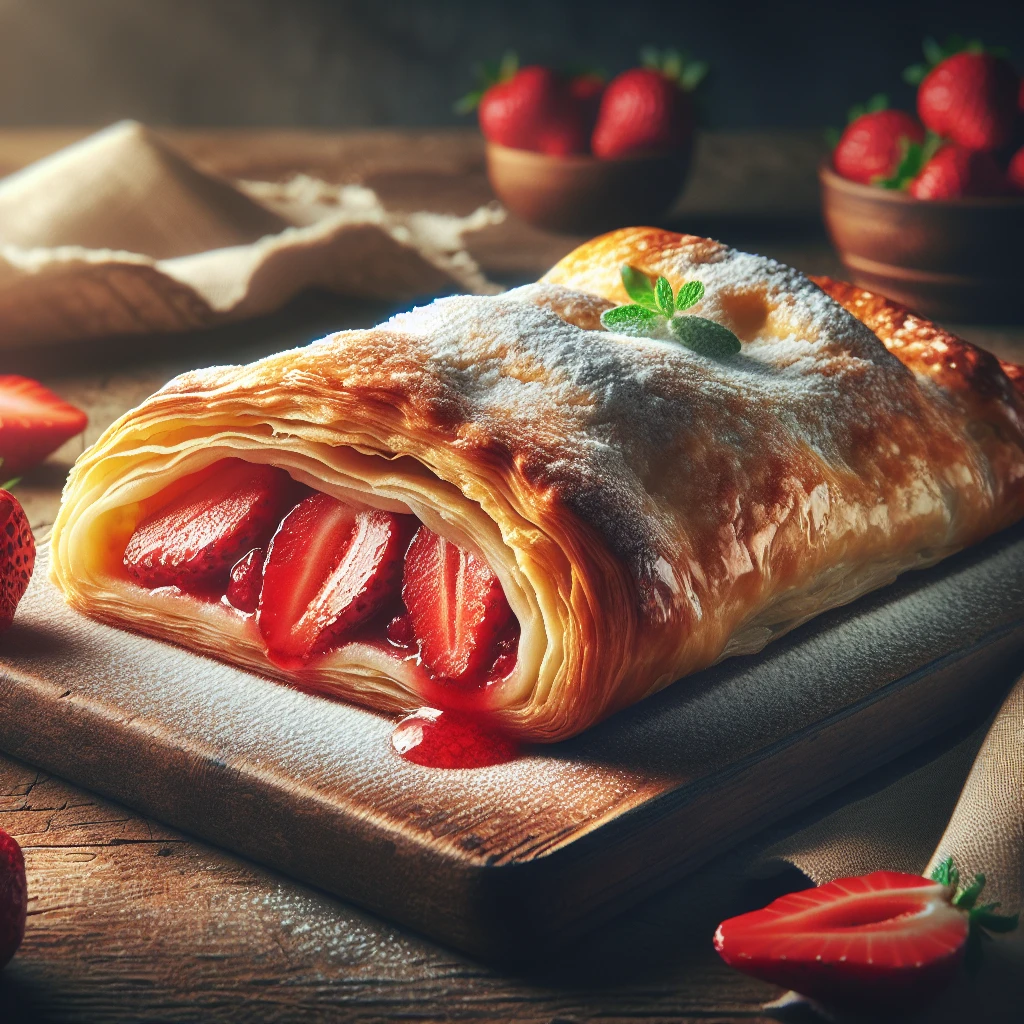
Why Strawberry Strudel Changes the Dessert Game Forever
Ever wonder why a warm, perfectly baked strawberry strudel makes a regular Tuesday morning feel exactly like a relaxed Sunday weekend? Let me tell you straight up: grabbing a massive slice of strawberry strudel alongside a strong cup of coffee is an absolute mood booster. We are talking about layers upon layers of shatteringly crisp pastry wrapped around a hot, jammy, sweet-tart center.
Years ago, when I was living near a tiny, hidden-gem bakery in Lviv, they served these enormous, flaky pastries absolutely stuffed with locally picked berries. It wasn’t the traditional apple filling everyone expects from classic bakeries; it was bursting with vibrant, ruby-red strawberry goodness. I literally spent weeks trying to recreate that exact crunch and sweetness in my own kitchen, failing a few times before finally nailing the formula. Now, I’ve got the entire method down to a total science. You are going to learn exactly how to pull off that high-end bakery-level magic without losing your mind over overly complicated pastry folding techniques. Trust me, your kitchen is about to smell incredible, and your friends will practically beg for the recipe. It is time to master this bake.
The Core Secrets of a Flawless Pastry
A true strudel is not just fruit haphazardly wrapped up in some random dough; it is a meticulously crafted experience built on intense textural contrast. You absolutely need that shatter-crisp exterior combined with the gooey, sweet, and slightly tart interior. Making this sweet treat at home offers massive advantages over buying it from a shop. First, you get to control the sugar levels entirely, allowing the natural, bright fruit flavor to shine instead of burying it under cloying, artificial sweetness. Second, you get to slice into it fresh out of the oven when the crispness is at its absolute, undeniable peak—something a store-bought pastry sitting in a display case simply cannot offer.
To really understand your options, look at how different doughs stack up when you are planning your baking session:
| Dough Type | Effort Level | Crisp Factor |
|---|---|---|
| Store-Bought Puff Pastry | Very Low | High (Thick and buttery) |
| Phyllo Dough Sheets | Medium | Extremely High (Shattery) |
| Traditional Hand-Stretched Dough | Very High | Perfect Authentic Crunch |
If you want to guarantee success on your first try, you need to respect the three pillars of a successful bake. Missing even one of these can lead to a sad, soggy dessert.
- Moisture management: Strawberries release a huge amount of water when heated. Using the right thickening agents is completely non-negotiable.
- Temperature control: Keeping your fat sources cold ensures maximum flakiness once the pastry hits the hot oven.
- Heat distribution: Baking your roll on a preheated pizza stone or a heavy-duty baking sheet guarantees a crisp bottom layer, preventing the dreaded soggy base.
The Ancient Origins of Thin Dough
To fully appreciate what you are making, we have to look back at where this brilliant concept originated. The roots of stretching dough until it is paper-thin go way back to the Middle Eastern baklava traditions. The Ottoman Empire brought these techniques into Eastern Europe, where the Austro-Hungarian bakers eventually adapted them. They realized that wrapping thin layers of dough around local fruits created a portable, highly satisfying treat that could feed a large family cheaply. The technique required patience, skill, and a massive table, turning baking into a communal event.
The Evolution of Fruit Fillings
For centuries, apples were the undisputed king of the filling world because they stored well through harsh winters and possessed the perfect texture for baking. But as agricultural practices shifted and fresh berries became more accessible to everyday home cooks, bakers started experimenting. Strawberries brought a completely different flavor profile to the table—brighter, slightly acidic, and highly fragrant. Mixing them with a touch of sugar and breadcrumbs completely revolutionized the traditional dessert, turning it from a heavy winter staple into a vibrant spring and summer celebration.
The Modern State of Strawberry Strudel
Right now, as we navigate through 2026, the global bakery scene is seeing a massive shift back to hyper-local, seasonal fruit pastries rather than relying on heavy fondant cakes. People want real ingredients. Artisan cafes in cities from Vienna to Lviv are serving elevated versions of this classic, sometimes pairing the warm pastry with basil-infused cream or balsamic reductions. The beauty of this dessert is that it easily adapts to modern tastes while remaining heavily rooted in comforting tradition. It remains one of the most reliable ways to impress guests without needing professional culinary training.
The Maillard Reaction and Pastry Layers
Baking is basically chemistry you get to eat. When you slide your pastry into a hot oven, a beautifully complex process called the Maillard reaction takes over. This chemical reaction between amino acids and reducing sugars occurs rapidly above 300°F (150°C), creating those complex, deeply caramelized flavor notes on the golden-brown crust. Without this reaction, your dough would taste flat and uninteresting. Furthermore, the mechanics of lamination—whether using puff pastry or buttered phyllo—rely heavily on rapid water evaporation. As the water inside the butter turns into steam, it violently pushes the layers of dough apart, creating the signature flaky structure.
Fruit Pectin and Moisture Management
Strawberries are absolutely delicious, but from a baking perspective, they are little water balloons. Handling that moisture requires a solid understanding of starches and pectin. Pectin is a naturally occurring structural carbohydrate found in the cell walls of fruits, but strawberries are notoriously low in it compared to apples or citrus. This means they will not naturally gel up when cooked down. You have to intervene mechanically.
- Fresh strawberries consist of roughly 91% water, meaning they will absolutely drown your dough if left unchecked.
- Adding a starch like cornstarch or tapioca flour triggers a process called gelatinization at around 160°F (71°C), trapping the fruit juices into a thick, sliceable gel.
- Toasted breadcrumbs act as a secondary defense mechanism; scattering a thin layer beneath the fruit absorbs rogue liquids before they can penetrate the bottom crust.
Step 1: Prepping the Berries
Start by sourcing the best strawberries you can find. Wash them thoroughly, hull them, and slice them into uniform quarters. Uniformity is crucial here because it ensures all the pieces cook down at the exact same rate. If you have massive berries, dice them into eighths. You want roughly four cups of prepped fruit.
Step 2: Mixing the Thickeners
In a large mixing bowl, toss your freshly cut berries with half a cup of granulated sugar, a generous splash of fresh lemon juice, and three tablespoons of cornstarch. The lemon juice not only brightens the overall flavor but also activates the starches more efficiently. Let this mixture sit for exactly ten minutes so the juices start to extract naturally.
Step 3: Rolling the Dough
Clear your kitchen counter and lightly dust it with all-purpose flour. If you are using store-bought puff pastry, roll it out gently until you have a rectangle roughly 10 by 14 inches. You do not want it so thin that it tears, but it needs to be thin enough to bake all the way through without leaving a raw, doughy center.
Step 4: Layering the Filling
Before adding the fruit, sprinkle a quarter cup of finely crushed, toasted breadcrumbs or crushed graham crackers down the center of your rolled dough. Leave a solid two-inch border all the way around. Use a slotted spoon to transfer your strawberry mixture over the breadcrumbs, leaving the excess liquid behind in the bowl. That leftover juice will ruin your pastry, so ditch it.
Step 5: The Folding Technique
Fold the short ends of the dough over the fruit first. Then, take one of the long sides and fold it tightly over the center. Brush a little bit of water or egg wash along the remaining edge, and fold it over to seal the entire log tightly. Carefully transfer the log, seam side down, onto a baking sheet lined with high-quality parchment paper.
Step 6: Egg Wash and Scoring
Whisk one large egg with a tablespoon of water and brush this mixture generously over the entire surface of your pastry. This is what guarantees that bakery-style golden shine. Take a sharp paring knife and cut four to five diagonal slits across the top. These vents are critical—they allow the steam to escape so your pastry does not explode in the oven.
Step 7: Baking and Cooling
Bake in a preheated oven at 400°F (200°C) for about 35 to 40 minutes. You are looking for a deep, rich golden brown color, and you should see the strawberry filling actively bubbling through the vents. When done, remove it from the oven and let it cool on the pan for at least 30 minutes. Slicing it too hot will result in a messy, collapsing disaster.
Myths vs. Reality in Pastry Baking
Myth: Making this type of dessert from scratch is incredibly difficult and requires professional training.
Reality: While traditional hand-stretched dough takes practice, using quality store-bought puff pastry or phyllo dough cuts the work down to practically nothing. It is actually a very forgiving process.
Myth: You can only use fresh strawberries; frozen ones will ruin the texture.
Reality: Frozen strawberries work perfectly well as long as you thaw them completely and thoroughly drain the excess liquid before mixing them with your starches.
Myth: A soggy bottom means you completely ruined the bake.
Reality: You can easily salvage a slightly soft bottom by tossing the pastry back into a hot oven on a pre-heated metal tray for a few extra minutes to crisp up the base.
Myth: It needs to be loaded with cups of sugar to taste good.
Reality: Adding a splash of citrus enhances the natural sweetness of the berries, allowing you to easily cut the refined sugar in half without sacrificing flavor.
Can I freeze unbaked strudel?
Yes, absolutely. Wrap the unbaked log tightly in a layer of plastic wrap and then a layer of aluminum foil. When you are ready, bake it straight from frozen, just adding about 15 extra minutes to your total baking time.
What is the absolute best thickener for berries?
Cornstarch or tapioca flour work best for high-water berries. Flour can leave a cloudy, gummy texture, whereas cornstarch keeps the fruit filling glossy and bright.
How long does the baked pastry stay fresh?
It is undoubtedly best on day one when the crunch is maximal, but it lasts up to 3 days stored in an airtight container in the fridge. Always reheat slices in the oven or air fryer, never the microwave.
Can I use regular puff pastry?
Yes. It is the ultimate shortcut for weeknight baking. It provides a thicker, more buttery crust compared to traditional dough, but it is incredibly delicious.
Do I really need to use breadcrumbs?
Yes, they act as a crucial sponge. A thin layer of toasted breadcrumbs absorbs rogue juices that the cornstarch might miss, protecting your bottom crust.
Why did mine burst open in the oven?
This almost always happens because the pastry lacked sufficient vent slits on top. The boiling fruit creates steam, and that steam needs a clear escape route.
Can I add a layer of cream cheese?
Highly recommended! Spreading a thin layer of sweetened, softened cream cheese underneath the berries before folding adds incredible richness and mimics a cheesecake flavor profile.
How do I know when it is fully baked?
The pastry should be a deep golden brown, not pale. More importantly, you should see the fruit juices visibly boiling and thickening through the steam vents.
There you have it. You are officially equipped with every single detail, tip, and scientific trick needed to execute the ultimate bake. Time to grab your rolling pin, hit up the grocery store or local farmer’s market, grab the freshest berries you can find, and get to work. Let me know exactly how your kitchen adventure turns out in the comments below!
Leave a Reply